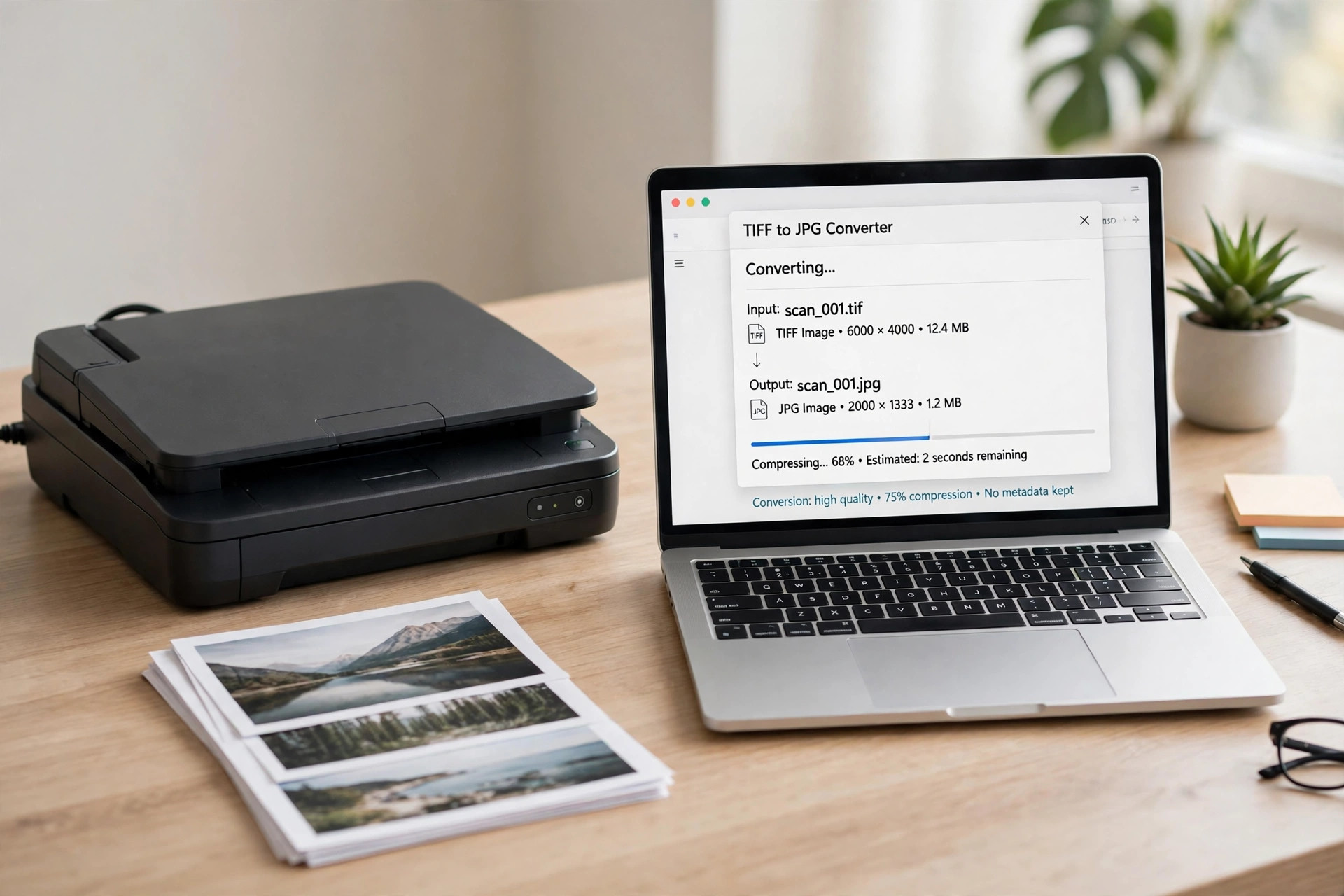
TIFF files hold superb detail, but they are huge and many apps cannot open them. When you convert TIFF to JPG, the same photo becomes far smaller and works almost everywhere. This guide shows free online and offline methods for every need. It also covers batch steps and quality settings for sharp results.
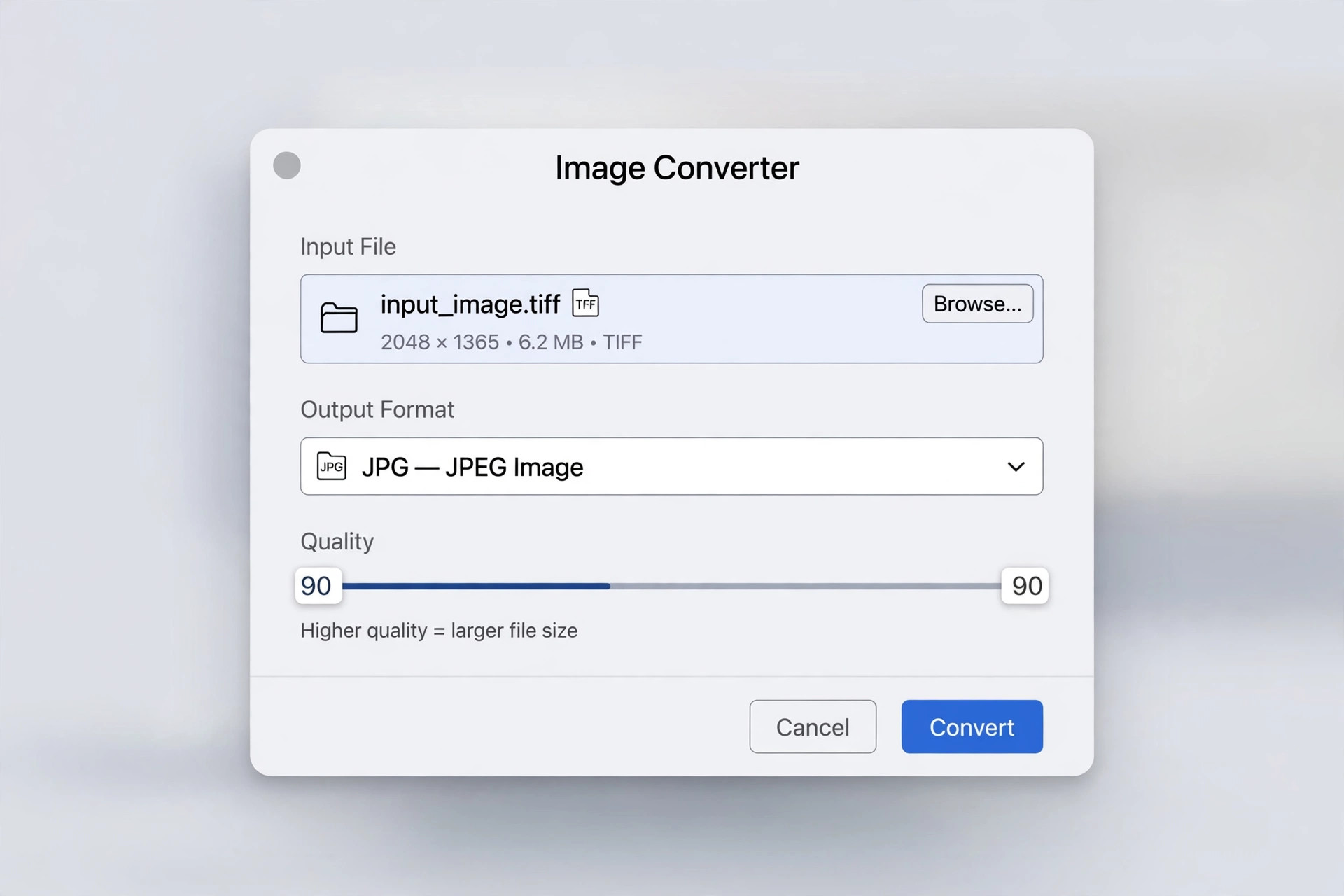
What Is TIFF and Why Convert It to JPG
TIFF is a lossless format used by scanners, cameras, and print shops. It stores every pixel with no compression damage, so files grow very large. Scanned documents and edited photos often arrive as TIFF files. Email forms, websites, and phone apps usually reject files that large. That is why many people convert TIFF to JPG before sharing.
Our guide on converting scanned documents to PDF handles TIFF scans too. Our guide on converting HEIC photos to JPG solves the same large-file problem. For size targets after conversion, read our guide on compressing an image to 200KB.
Method 1: Convert TIFF to JPG Online in CloudConvert
CloudConvert is a trusted online converter with a free daily allowance. It runs in the browser, so you install nothing on your device. Converted files are deleted from its servers after one day.
Step 1: Open the CloudConvert TIFF to JPG page in your browser.
Step 2: Click Select File and upload one or more TIFF images.
Step 3: Set the output format to JPG and pick a quality level.
Step 4: Click Convert, wait for the job, then download the JPG files.
Step 5: Check each JPG opens cleanly before you delete the TIFF originals.
The free plan covers 25 conversions per day for most users. For larger batches, split the job across days or use offline tools below.
Method 2: Convert TIFF to JPG Online in Convertio
Convertio is a simple browser converter with no account needed. You can upload files from your device, Google Drive, or Dropbox. The free plan allows files up to 100 MB each in size.
Step 1: Open the Convertio TIFF to JPG page in your browser.
Step 2: Click Choose Files and add the TIFF images to convert.
Step 3: Confirm JPG is set as the output format for each file.
Step 4: Click Convert and download the JPG files when ready.
Convertio deletes uploaded files after 24 hours for privacy. If your TIFF file is very large, try CloudConvert or GIMP instead.
Method 3: Convert TIFF to JPG Offline in GIMP
GIMP is a free open-source editor that opens TIFF files directly. It works offline, so private scans never leave your computer. You can also adjust quality, size, and colour before you export.
Step 1: Download GIMP from its official site and install it free.
Step 2: Open GIMP, choose File, then Open, and select your TIFF image.
Step 3: Choose File, then Export As, and save the file as JPG.
Step 4: Set the quality slider near 90 and click Export to save.
A quality near 90 keeps scans sharp with a small file size. For a full guide on shrinking JPGs after export, read our image compression guide.
Method 4: Batch Convert TIFF to JPG on Windows and Mac
Batch conversion saves time when you have dozens of TIFF files. XnConvert is a free batch tool that runs on Windows and Mac. It converts whole folders in one run with the same settings.
Step 1: Download XnConvert free and install it on your computer.
Step 2: Add the TIFF files or a whole folder to the Input tab.
Step 3: In the Output tab, set the format to JPG and pick a folder.
Step 4: Click Convert and let it process every file in the list.
Check a few outputs first, since one bad setting affects the whole batch. Keep the TIFF originals until you confirm every JPG looks right.
How to Keep Quality High When You Convert
TIFF to JPG conversion is lossy, so some detail is always lost. When you convert TIFF to JPG, start from the original TIFF file. Use a quality setting of 85 to 95 for photos you will print. Use 75 to 85 for web uploads, where small files load faster. Avoid converting the same image twice, since each pass loses detail. If the JPG looks soft, raise the quality and convert it again.
Our guide to compress an image to 100KB shows how to shrink JPGs further. Try it after conversion if the JPG is still too large.
Mistakes to Avoid When You Convert TIFF Files
Do not delete the TIFF originals until every JPG is checked. Do not use a shady converter that asks you to install extra software. Do not convert a tiny TIFF to a huge JPG and expect more detail. Do not upload private scans to a converter you do not trust. Do not forget that JPG has no transparency, unlike PNG files.
For clear backgrounds, read our guide on removing the background from a logo.
Frequently Asked Questions
Can I convert TIFF to JPG for free?
Yes, CloudConvert, Convertio, and GIMP all convert TIFF to JPG free. Free plans have daily limits, but most one-off jobs fit inside them.
Will converting TIFF to JPG reduce image quality?
Yes, JPG uses lossy compression, so a little detail is lost each time. Use a quality setting of 90 or above to keep the loss invisible.
Can I convert many TIFF files to JPG at once?
Yes, XnConvert converts whole folders in one run with shared settings. CloudConvert also accepts several files in a single free job.
Why is my TIFF file so large?
TIFF stores every pixel without lossy compression, so detail costs space. Converting to JPG at quality 90 shrinks the file by a large amount.
What should I do if an app cannot open my TIFF file?
Convert the file to JPG with any free method in this guide. Keep the TIFF original safe, since you may need it again later.
Converting TIFF to JPG takes only a minute with the free tools above. Pick an online converter for quick jobs and GIMP for private scans. Set the quality near 90, check the result, and share the JPG anywhere.
Leave a Reply