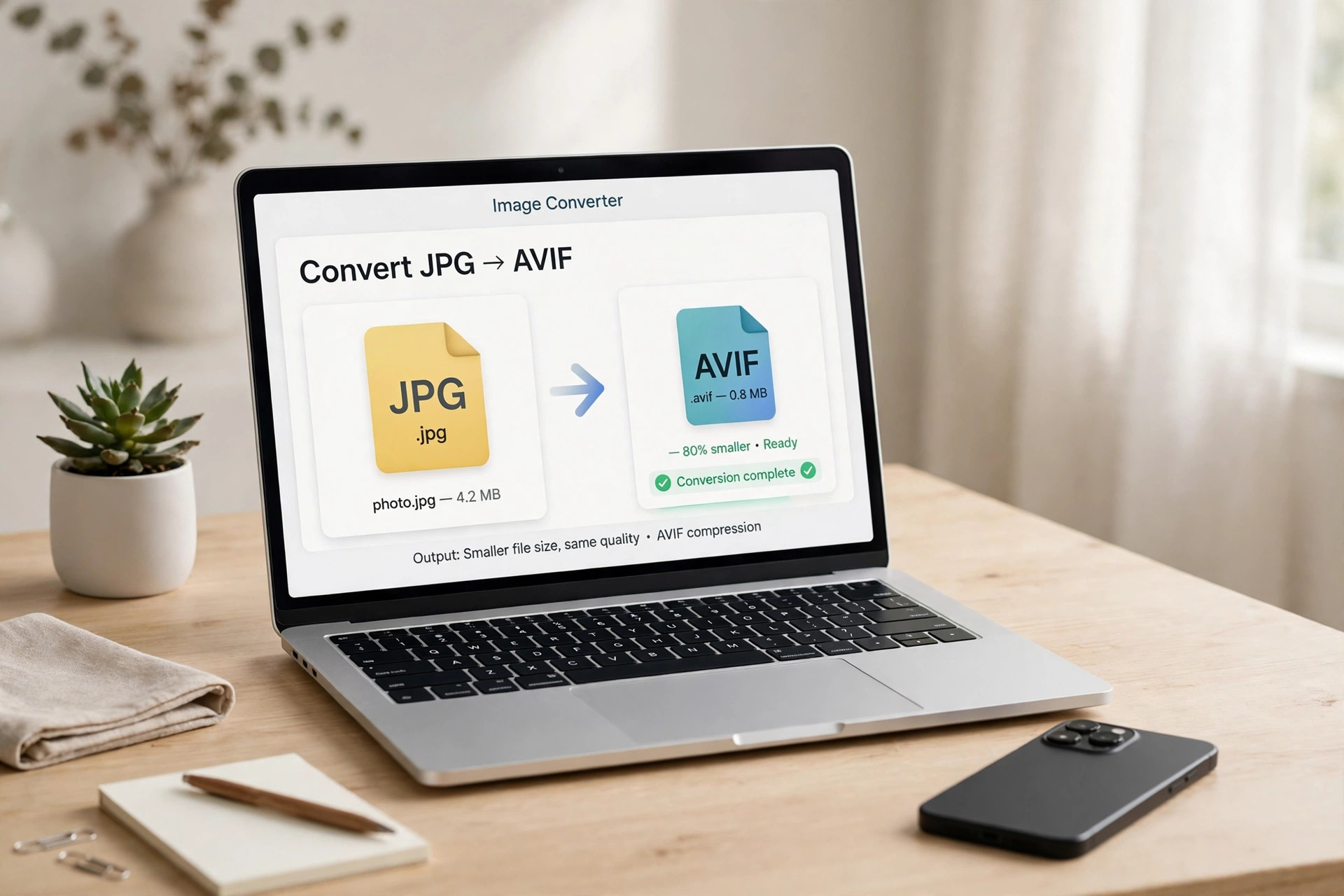
JPG photos work everywhere, but their files are often larger than needed. When you convert JPG to AVIF, the same photo can shrink a lot. It can shrink by up to half with no visible quality loss. This guide shows free online and offline methods that work in minutes. It also covers batch conversion and quality settings for sharp results.
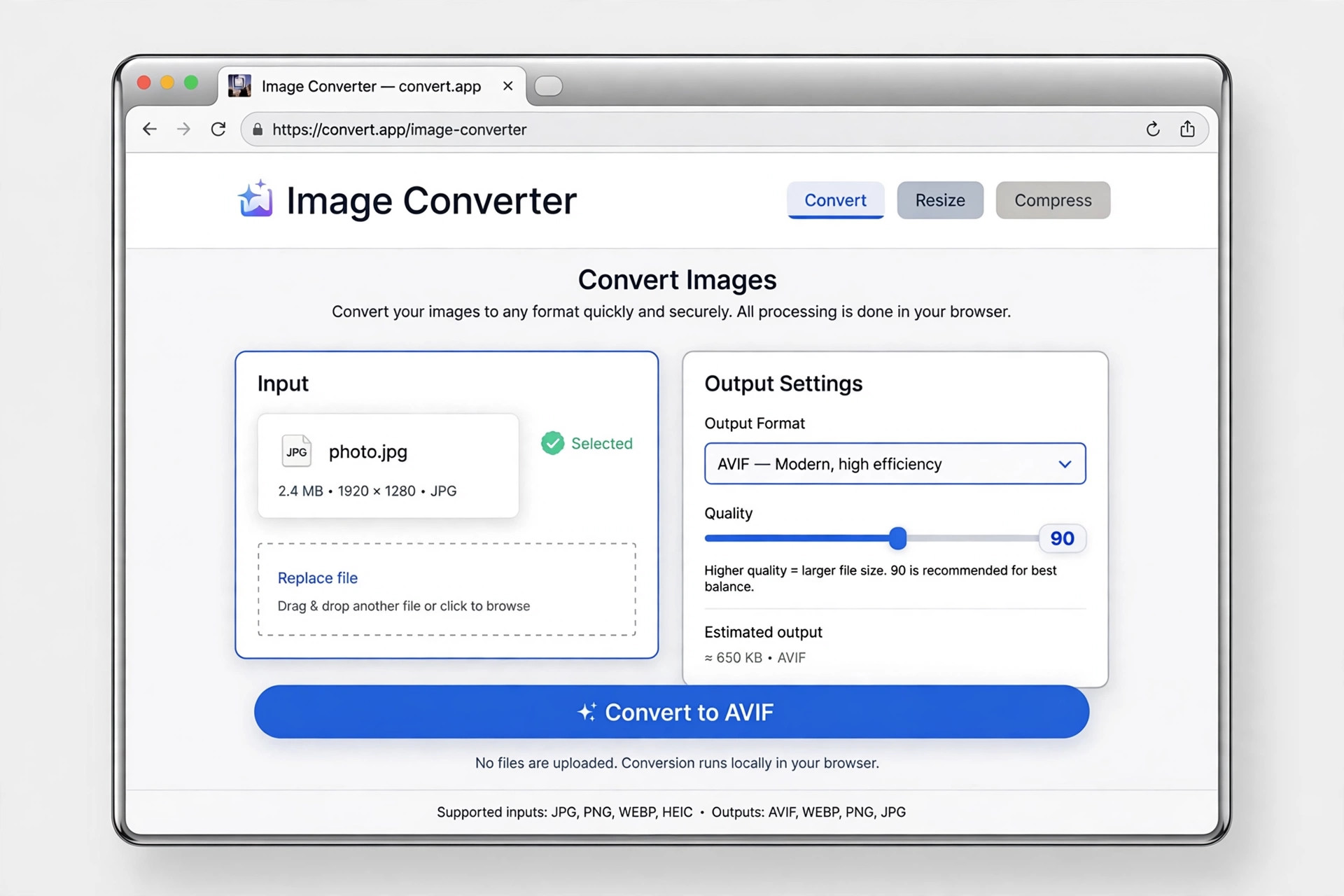
What Is AVIF and Why Convert JPG Files
AVIF is a modern image format built on the AV1 video codec. It stores sharp photos at much smaller file sizes than JPG. Many new phones and browsers now support AVIF files natively. Older editors, upload forms, and office apps may still reject AVIF files. That tradeoff matters, so choose AVIF when size and loading speed matter most.
Our guide on JPG vs PNG vs WebP explains which format fits each job. Our guide on converting JPG to WebP shows a smaller step toward modern formats. If you ever need the reverse, read our guide on converting AVIF to JPG.
Method 1: Convert JPG to AVIF Online in CloudConvert
CloudConvert is a trusted online converter with a free daily allowance. It runs in the browser, so you install nothing on your device. Converted files are deleted from its servers after one day.
Step 1: Open the CloudConvert JPG to AVIF page in your browser.
Step 2: Click Select File and upload one or more JPG images.
Step 3: Set the output format to AVIF and pick a quality level.
Step 4: Click Convert, wait for the job, then download the AVIF files.
Step 5: Check each AVIF opens cleanly before you delete the JPG originals.
The free plan covers 25 conversions per day for most users. For larger batches, split the job across days or use offline tools below.
Method 2: Convert JPG to AVIF Online in Convertio
Convertio is a simple browser converter with no account needed. You can upload files from your device, Google Drive, or Dropbox. The free plan allows files up to 100 MB each in size.
Step 1: Open the Convertio JPG to AVIF page in your browser.
Step 2: Click Choose Files and add the JPG images to convert.
Step 3: Confirm AVIF is set as the output format for each file.
Step 4: Click Convert and download the AVIF files when ready.
Convertio deletes uploaded files after 24 hours for privacy. If your JPG file is very large, try CloudConvert or GIMP instead.
Method 3: Convert JPG to AVIF Offline in GIMP
GIMP is a free open-source editor that can export AVIF files directly. It works offline, so private photos never leave your computer. You can also adjust quality, size, and colour before you export.
Step 1: Download GIMP from its official site and install it free.
Step 2: Open GIMP, choose File, then Open, and select your JPG image.
Step 3: Choose File, then Export As, and save the file as AVIF.
Step 4: Set the quality slider near 90 and click Export to save.
A quality near 90 keeps photos sharp with a small file size. For a full guide on shrinking JPGs first, read our image compression guide.
Method 4: Batch Convert JPG to AVIF on Windows and Mac
Batch conversion saves time when you have dozens of JPG files. XnConvert is a free batch tool that runs on Windows and Mac. It converts whole folders in one run with the same settings.
Step 1: Download XnConvert free and install it on your computer.
Step 2: Add the JPG files or a whole folder to the Input tab.
Step 3: In the Output tab, set the format to AVIF and pick a folder.
Step 4: Click Convert and let it process every file in the list.
Check a few outputs first, since one bad setting affects the whole batch. Keep the JPG originals until you confirm every AVIF looks right.
How to Keep Quality High When You Convert
JPG to AVIF conversion starts from a lossy file, so some detail is already gone. When you convert JPG to AVIF, start from the best JPG you have. Use a quality setting of 85 to 95 for photos you will print. Use 75 to 85 for web uploads, where small files load faster. Avoid converting the same image twice, since each pass loses detail. If the AVIF looks soft, raise the quality and convert it again.
Our guide to compress an image to 100KB shows how to shrink files further. Try it after conversion if the AVIF is still too large.
Mistakes to Avoid When You Convert JPG Files
Do not delete the JPG originals until every AVIF is checked. Do not use a shady converter that asks you to install extra software. Do not convert a tiny JPG to a huge AVIF and expect more detail. Do not upload private photos to a converter you do not trust. Do not forget that some older apps still cannot open AVIF files.
To prepare photos for selling, read our guide on product photos for online stores.
Frequently Asked Questions
Can I convert JPG to AVIF for free?
Yes, CloudConvert, Convertio, and GIMP all convert JPG to AVIF free. Free plans have daily limits, but most one-off jobs fit inside them.
Will converting JPG to AVIF reduce image quality?
JPG is already lossy, so AVIF cannot restore lost detail. At quality 90 or above, the visible difference is usually none.
Can I convert many JPG files to AVIF at once?
Yes, XnConvert converts whole folders in one run with shared settings. CloudConvert also accepts several files in a single free job.
Is AVIF better than JPG for websites?
AVIF gives smaller files at the same quality, so pages load faster. Keep a JPG copy for apps and browsers that cannot open AVIF.
What should I do if an app cannot open my AVIF file?
Convert the file back to JPG with any free method in this guide. Keep the AVIF original safe, since you may need it again later.
Converting JPG to AVIF takes only a minute with the free tools above. Pick an online converter for quick jobs and GIMP for private photos. Set the quality near 90, check the result, and enjoy smaller files.
Leave a Reply