If you’ve ever tried to budget and felt like you were just guessing—hoping you’d have money left at the end of the month—you’re not alone. Most people budget backward: they look at what they spent last month, maybe cut a little, and hope for the best.Zero-Based Budgeting Explained for Beginners
Zero-based budgeting flips that entire approach on its head. Instead of letting your past spending dictate your future, you start from zero every single month and decide exactly where every dollar will go before you spend it.
It sounds intense. It sounds like a lot of work. And honestly, it can be—especially at first. But for millions of people, zero-based budgeting is the difference between wondering where their money went and knowing exactly where every dollar is working.
This guide explains zero-based budgeting in plain English, with practical steps to implement it in 2026.
What Is Zero-Based Budgeting?
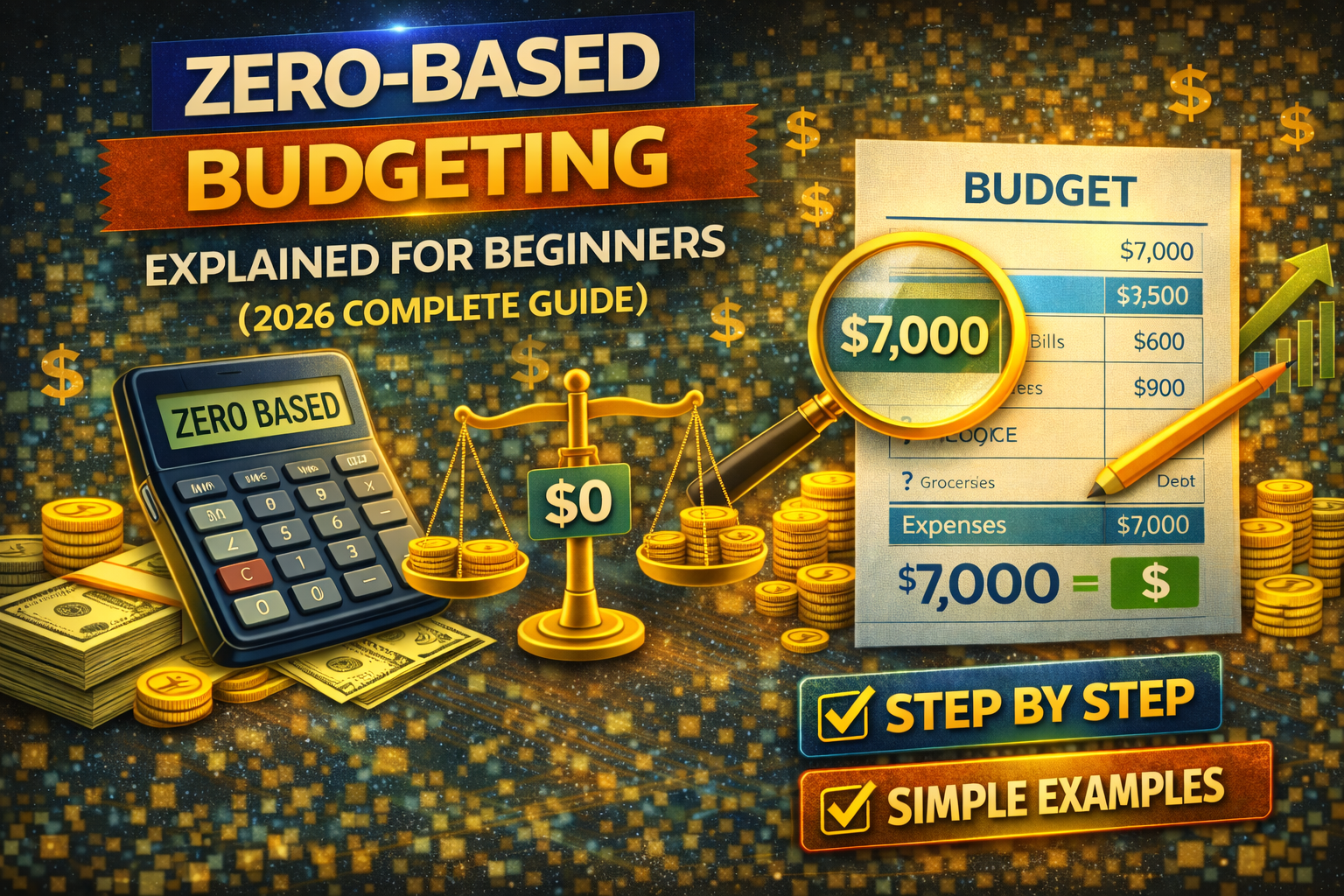
Zero-based budgeting is exactly what it sounds like: you start from zero at the beginning of each month and assign every dollar of income a specific job . When you’re done, your income minus your expenses equals zero .
This doesn’t mean you spend every dollar you earn. It means you give every dollar a purpose—whether that’s rent, groceries, savings, debt payments, or even fun money. Nothing is left unassigned.
The core principle: Income – Expenses = $0
If you have $3,000 coming in, every single dollar of that $3,000 gets allocated somewhere. By the time you finish your budget, there should be no “leftover” money wondering what to do .
How Zero-Based Budgeting Differs from Traditional Budgeting
To understand why zero-based budgeting is powerful, it helps to see how it’s different from what most people do.
| Traditional Budgeting | Zero-Based Budgeting |
|---|---|
| Looks at past spending to guess future needs | Starts from zero each month |
| Leaves “leftover” money unassigned | Every dollar has a job |
| Tracks where money went after spending | Decides where money goes before spending |
| Often feels restrictive and vague | Feels intentional and controlled |
| Can hide wasteful spending | Forces scrutiny of every expense |
In traditional budgeting, you might look at last month and see you spent $500 on groceries, so you budget $500 this month. But what if you could actually spend $450? Zero-based budgeting forces you to ask that question every single month .
Why Zero-Based Budgeting Works
1. It Forces Intentionality
When you have to assign every dollar a job, you can’t just “wing it.” You have to make conscious decisions about what matters to you. That daily coffee run? You have to choose it over something else. That savings goal? You have to fund it on purpose .
2. It Reveals Wasteful Spending
When you look at your spending categories and have to justify every dollar, it’s amazing how quickly you spot waste. Do you really need $200 for dining out? Could that be $150? The process forces you to scrutinize .
3. It Prioritizes Goals
If you want to save for a house, pay off debt, or build an emergency fund, zero-based budgeting makes those goals non-negotiable. You fund them first, then build the rest of your budget around what’s left .
4. It Reduces Financial Anxiety
When you know exactly where your money is going, there are no surprises. You’re not hoping you have enough for rent—you know you do because you already assigned that money .
5. It Adapts to Changing Circumstances
Life changes month to month. One month you might have a car insurance bill; another month you might have holiday gifts. Zero-based budgeting handles this naturally because you build a new budget every month .
The Zero-Based Budgeting Process: Step by Step
Step 1: Calculate Your Monthly Income
Start with your take-home pay—the amount that actually hits your bank account after taxes and deductions. If your income varies (freelancers, gig workers, commission-based jobs), use your lowest-earning month from the past year as your baseline . This conservative approach prevents you from budgeting money you might not receive.
Step 2: List All Your Expenses
Write down everything you spend money on. Be thorough. Include:
- Fixed expenses: Rent/mortgage, utilities, insurance, minimum debt payments
- Variable expenses: Groceries, gas, dining out, entertainment, personal care
- Irregular expenses: Car maintenance, annual subscriptions, gifts, medical copays
- Savings goals: Emergency fund, retirement, vacation fund, down payment
- Debt payments above minimum: Extra toward credit cards, loans, or mortgages
Step 3: Give Every Dollar a Job
This is the heart of zero-based budgeting. Start assigning your income to each expense category until every dollar is accounted for. Prioritize the essentials first: housing, utilities, food, transportation, minimum debt payments .
Then move to savings goals and debt acceleration. Finally, assign money to discretionary categories like dining out and entertainment.
Step 4: Check That Income Minus Expenses Equals Zero
Add up all your assigned expenses. Subtract from your income. The result should be zero. If you have money left over, assign it somewhere—add it to savings, put it toward debt, or increase a discretionary category .
If you have a negative number (expenses exceed income), you need to cut somewhere. That’s the tough part—but it’s better to face it on paper than in real life when bills come due.
Step 5: Track Your Spending Throughout the Month
A budget is only as good as your ability to follow it. Track your spending against your categories. Apps like YNAB, EveryDollar, and Goodbudget make this easy . When you overspend in one category, you have to take money from another category to cover it. That’s called “rolling with the punches” .
Step 6: Start Fresh Next Month
At the end of the month, you start over. Any money left in categories can be rolled over or assigned to new goals. But you build a new budget from scratch, based on the upcoming month’s unique needs .
Sample Zero-Based Budget
Let’s walk through an example to make this concrete.
Monthly Income: $4,000 (after taxes)
| Category | Amount |
|---|---|
| Rent | $1,200 |
| Utilities | $300 |
| Groceries | $400 |
| Transportation | $250 |
| Health insurance | $200 |
| Minimum debt payments | $300 |
| Total Needs | $2,650 |
| Dining out | $200 |
| Entertainment | $100 |
| Shopping | $100 |
| Subscriptions | $50 |
| Total Wants | $450 |
| Emergency fund | $200 |
| Retirement | $300 |
| Extra debt payment | $200 |
| Vacation savings | $100 |
| Holiday gifts | $100 |
| Total Savings | $900 |
Total Allocated: $4,000
Remaining: $0
Every dollar has a job. Needs are covered. Wants are included. Savings are funded. There’s no “extra” money wondering what to do.
Common Zero-Based Budgeting Mistakes
1. Forgetting Irregular Expenses
Annual insurance premiums, car registrations, holiday gifts—these will blow up your budget if you don’t plan for them. Include them as monthly “sinking funds” so the money is there when the bill arrives .
2. Being Too Restrictive
If your budget leaves no room for fun, you’ll quit. Include reasonable amounts for dining out, entertainment, and personal spending. A budget you can stick to is better than a perfect one you abandon .
3. Not Tracking Spending
Creating the budget is only half the battle. If you don’t track actual spending against your categories, you have no idea whether you’re following your plan .
4. Giving Up After One Bad Month
You will have months where you overspend. Life happens. The goal isn’t perfection—it’s progress. Learn from the month and adjust next month’s budget .
5. Not Involving Your Partner
If you share finances, both partners need to be on board. Budget together, agree on categories, and review progress regularly. Money disagreements are one of the leading causes of relationship stress—a shared budget reduces that .
Tools for Zero-Based Budgeting
Best Apps for 2026
| App | Best For | Price | Key Feature |
|---|---|---|---|
| YNAB | Accountability and education | $14.99/month | Four rules methodology, workshops |
| EveryDollar | Dave Ramsey followers | Free / $17.99 | Zero-based simplicity, Ramsey method |
| Goodbudget | Envelope-style budgeting | Free / $8/month | Digital envelopes, family sync |
| EnvelopeBudget | Modern features | Free trial / $4/month | AI coaching, dark mode |
| RealBudget | Custom periods | Free / $3-10/month | Multiple budget cycles |
Spreadsheet Option
For total control, Google Sheets or Excel templates work beautifully. Many free templates are available online. The downside is manual entry and no automatic bank sync—but some people prefer the intentionality .
Zero-Based Budgeting for Irregular Income
If your income varies month to month (freelancers, gig workers, commission-based jobs), zero-based budgeting still works—you just need to adapt.
Strategy 1: Budget from your lowest-earning month. Use your most conservative income estimate as the baseline. Any extra money that comes in can be assigned to savings, debt, or discretionary categories after the fact .
Strategy 2: Budget based on what’s already in the bank. Instead of budgeting future income, budget the money you actually have right now. This is the “age your money” approach that YNAB teaches—you’re always spending money you earned at least 30 days ago .
Strategy 3: Use the “pay yourself first” method. When a big check comes in, immediately assign portions to upcoming fixed expenses, then to savings, then to variable spending. You’re essentially building your budget in real-time as money arrives .
Frequently Asked Questions
Does zero-based budgeting mean I can’t have fun?
Not at all. It means you decide in advance how much fun money you have. You can absolutely include dining out, entertainment, and hobbies in your budget. The difference is you’re intentional about it .
What if I have money left at the end of the month?
Congratulations! Now you get to decide what to do with it. Add it to savings, put it toward debt, roll it into next month’s budget, or treat yourself. The key is making a conscious choice .
Is zero-based budgeting hard?
At first, yes. Tracking every expense and building a detailed budget takes time and mental energy. But like any habit, it gets easier. After a few months, most people find it takes 30-60 minutes per month .
Can I do zero-based budgeting with a partner?
Absolutely. In fact, it’s better with a partner because you’re both on the same page. Schedule a monthly “money date” to build the budget together and review progress .
What’s the difference between zero-based budgeting and envelope budgeting?
They’re closely related. Envelope budgeting is a method of implementing zero-based budgeting—you put cash in physical or digital envelopes for each category. When the envelope is empty, you stop spending. Zero-based budgeting is the broader philosophy of assigning every dollar a job .
Your 30-Day Zero-Based Budgeting Sprint
Week 1: Preparation
- Calculate your average monthly income
- Track every expense for 7 days
- List all your fixed and variable expenses
- Identify irregular expenses from the past year
Week 2: Build Your First Budget
- Choose your budgeting tool (app or spreadsheet)
- List all expense categories
- Assign every dollar of your next month’s income
- Verify that income minus expenses equals zero
Week 3: Track and Adjust
- Record every purchase against your categories
- If you overspend in one category, move money from another
- Note where your estimates were off
Week 4: Review and Plan Next Month
- Review how the month went
- Adjust categories based on what you learned
- Build your next month’s budget from scratch
- Celebrate your progress
The Bottom Line
Zero-based budgeting is one of the most powerful tools you can use to take control of your money. It’s not about restriction—it’s about intention. It’s not about never having fun—it’s about choosing what fun means to you and funding it on purpose.
The process forces you to look at your spending, prioritize what matters, and make conscious choices. It reveals waste, accelerates goals, and reduces financial anxiety.
Will it take work? Yes, especially at first. But the peace of mind that comes from knowing exactly where your money is going is worth every minute.
Start with one month. Track your expenses. Build a budget from zero. See how it feels. For most people, once they try zero-based budgeting, they never go back.
Your future self—and your bank account—will thank you.
1 thought on “Zero-Based Budgeting Explained for Beginners (2026 Complete Guide)”