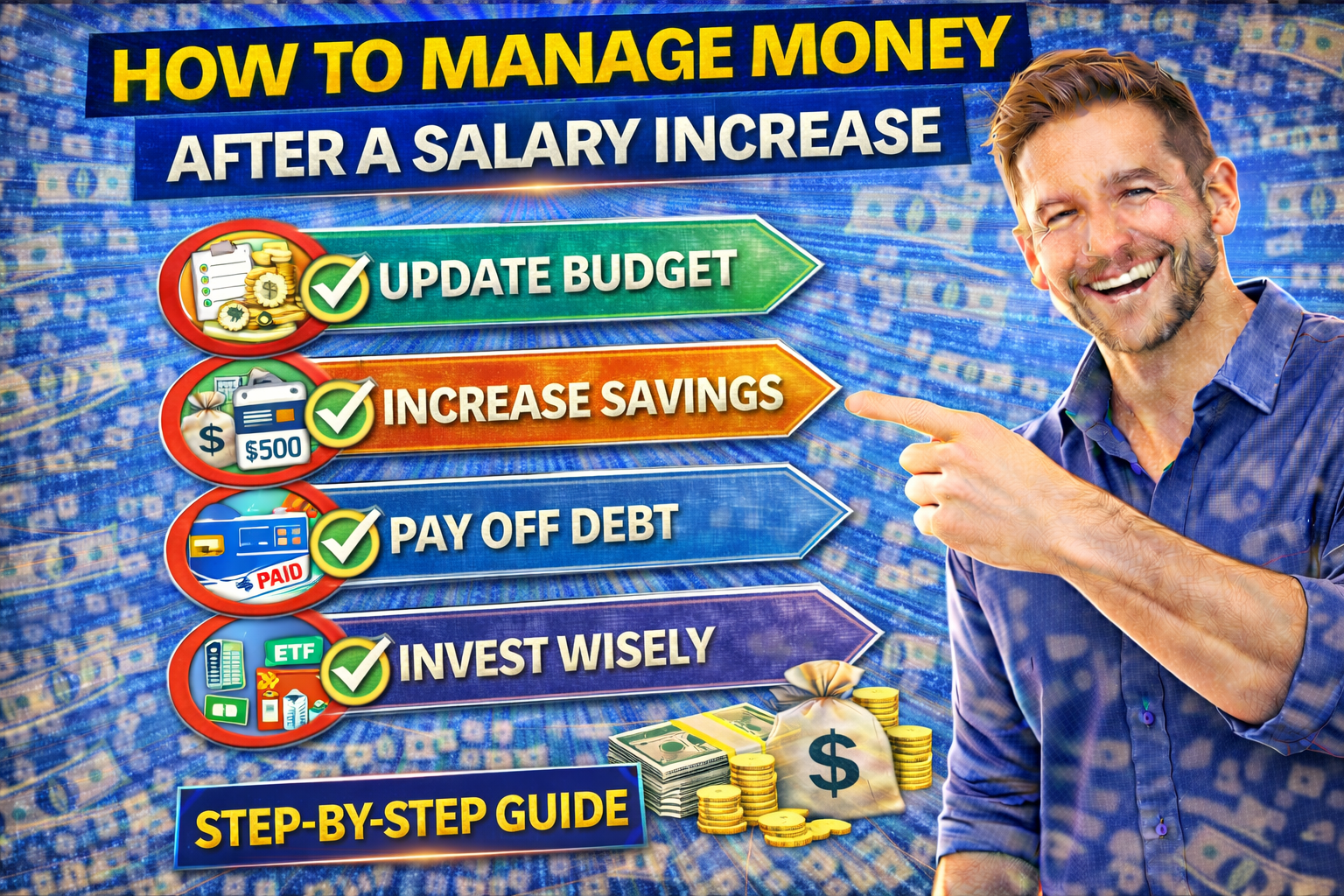
You got the raise. Maybe it was a promotion. Maybe a new job. Maybe that performance review finally paid off. How to Manage Money After a Salary Increase.
Congratulations. You deserve it.
But here’s the hard truth that nobody tells you: Most people who get raises end up no wealthier than before.
Sound crazy? It’s not. It’s called lifestyle inflation—or as some call it, “creep.” You start earning more, so you start spending more. Nicer car. Bigger apartment. Fancier restaurants. Soon, your expenses rise to exactly match your income, and you’re right back where you started—just with nicer stuff.
I’ve watched it happen to friends. I’ve almost let it happen to myself. And I’ve seen the small group of people who handle raises differently—the ones who use them to build lasting wealth instead of temporary status.
This guide is about joining that second group.
The Raise Trap: Why More Money Doesn’t Always Mean More Wealth
Let me paint you a picture of two people:
Sarah gets a $10,000 raise. She’s been wanting a new car, so she upgrades her lease. She eats out more because “she deserves it.” She buys nicer clothes for her new “professional image.” Within six months, her $10,000 raise is completely absorbed by higher expenses. She’s still living paycheck to paycheck—just with better stuff.
James gets the same $10,000 raise. He keeps living exactly as he did before. He directs the entire raise to his 401(k), Roth IRA, and a brokerage account. Ten years later, that $10,000—invested monthly—has grown to over $150,000. He’s built real wealth while Sarah is still making car payments.
Same raise. Completely different outcomes.
The difference wasn’t intelligence or income. It was behavior.
Step 1: Celebrate (But Don’t Spend)
First things first: You earned this. Celebrate.
Go to a nice dinner. Buy that thing you’ve been wanting. Take a weekend trip. Seriously. You should enjoy the fruits of your labor.
But here’s the key: Celebrate once, then get serious.
Pick a celebration budget—maybe 5-10% of your raise. Enjoy it guilt-free. Then move on.
The mistake people make is turning the celebration into a permanent lifestyle upgrade. That dinner becomes a habit. That weekend trip becomes a expectation. Before you know it, your raise is gone.
Celebrate the win. Don’t let the win become your new normal.
Step 2: Pause Before Changing Anything
When money hits your account, there’s a powerful urge to spend it. Your brain releases dopamine. You start thinking about all the things you couldn’t afford before.
Fight that urge by doing nothing for 30-60 days.
The 60-Day Rule:
For the first two months after your raise, don’t change a thing. Live exactly as you did before. Pretend the raise doesn’t exist.
This does two things:
- It proves you don’t need the extra money. You were fine before. You’ll be fine now. Any spending increases are choices, not necessities.
- It gives you time to plan. Instead of reacting emotionally, you make intentional decisions about where this money should go.
After 60 days, sit down and decide—calmly, intentionally—where every dollar of your raise will be allocated.
Step 3: Calculate Your “Real” Raise
Your raise isn’t as big as you think. Taxes take a bite.
The quick calculation:
If you got a $10,000 raise and you’re in the 22% tax bracket:
- Federal taxes: $2,200
- State taxes (if applicable): $500-$1,000
- FICA (Social Security/Medicare): $765
Net raise: roughly $6,000-$7,000
That’s $500-$583 per month. Still significant. But knowing the real number prevents you from planning around money that was never yours.
Pro tip: Update your W-4 withholding if needed. A big raise might push you into a higher bracket, and you don’t want to owe at tax time.
Step 4: The Hierarchy of Raise Allocation
Where should your raise go? Follow this priority order:
Level 1: The Foundation (Non-Negotiable)
1. High-Interest Debt (8%+)
If you have credit card debt, personal loans, or any debt above 8% interest, your raise should attack it aggressively.
Why: Paying off 20% credit card debt is the equivalent of earning a guaranteed 20% return. There’s no investment that offers that.
2. Emergency Fund
If you don’t have 3-6 months of expenses saved, direct your raise here until you do. Keep it in a high-yield savings account (4-5% currently).
Why: Without this, any unexpected expense becomes a crisis. An emergency fund turns surprises into inconveniences.
Level 2: The Future (Long-Term Wealth)
3. Retirement Accounts
If you have a 401(k) with an employer match, increase your contribution to at least get the full match. That’s free money—never leave it on the table.
If you’re already getting the match, consider:
- Increasing 401(k) contributions further (up to $23,500 in 2026)
- Opening or maxing a Roth IRA ($7,000 limit)
- Catching up contributions if you’re 50+ ($8,000 limit for IRA, $31,000 for 401(k))
4. Taxable Brokerage Account
Once tax-advantaged accounts are maxed, direct extra money to a regular brokerage account invested in low-cost index funds (VOO, VTI, VT).
Level 3: Medium-Term Goals
5. Major Purchase Savings
House down payment. Wedding fund. New car fund (if you’ll pay cash). Renovation money.
Keep this in a high-yield savings account or CDs if you need it within 3-5 years.
Level 4: Sustainable Lifestyle Upgrades
6. Intentional Lifestyle Inflation
After all the above, if money remains, you can increase your quality of life—intentionally.
Better apartment? Go for it. More travel? Absolutely. Regular massages? If it improves your life.
The key is intentionality. You’re not upgrading because you “deserve it” or because your friends spend more. You’re upgrading because you’ve already secured your future and have surplus to enjoy now.
Step 5: The 50/30/20 Rule for Raises
Here’s a simple framework for allocating any raise:
50% to Future You
Half of every raise goes to wealth-building. Retirement accounts, investments, debt payoff. This ensures you’re always moving forward.
30% to Current You
Upgrade your life. Better experiences, more convenience, things that genuinely improve your daily happiness.
20% to Catch-Up or Giving
Maybe you’re behind on retirement—this fills the gap. Maybe you want to donate more. Maybe you need to catch up on maintenance you’ve deferred.
Example $10,000 raise:
- $5,000: 401(k) increase, Roth IRA, extra debt payments
- $3,000: Nicer apartment, travel fund, hobby spending
- $2,000: Emergency fund top-up, charitable giving, home repairs
This framework ensures you’re always balancing present enjoyment with future security.
Step 6: Specific Allocation Scenarios
Scenario A: You Have High-Interest Debt
| Priority | Allocation | Action |
|---|---|---|
| 1 | 80-100% | Pay off credit cards, personal loans |
| 2 | 0-20% | Small lifestyle treat (don’t burn out) |
| 3 | After debt cleared | Invest aggressively |
Example $6,000 net raise:
- $5,000 to credit card debt
- $1,000 to celebrate (one-time, not recurring)
Scenario B: You Have No Debt, Emergency Fund is Solid
| Priority | Allocation | Action |
|---|---|---|
| 1 | 50% | Increase retirement contributions |
| 2 | 30% | Brokerage account (index funds) |
| 3 | 20% | Intentional lifestyle upgrade |
Example $6,000 net raise:
- $3,000 to Roth IRA/401(k)
- $1,800 to brokerage account
- $1,200 to travel fund (or other quality-of-life upgrade)
Scenario C: You’re Behind on Retirement
| Priority | Allocation | Action |
|---|---|---|
| 1 | 70-80% | Max retirement accounts |
| 2 | 10-15% | Brokerage catch-up |
| 3 | 5-10% | Lifestyle (maintain motivation) |
Example $6,000 net raise:
- $4,500 to 401(k) and Roth IRA
- $900 to brokerage
- $600 to life enjoyment
Scenario D: You Have Medium-Term Goals (House, Wedding)
| Priority | Allocation | Action |
|---|---|---|
| 1 | 60% | Goal-specific savings (high-yield account) |
| 2 | 30% | Retirement (don’t pause this) |
| 3 | 10% | Lifestyle |
Example $6,000 net raise:
- $3,600 to house down payment fund
- $1,800 to retirement
- $600 to celebrate progress
Step 7: The Automatic System
Willpower is overrated. Systems win.
Set up automation before you ever see the money:
- Increase 401(k) contribution through HR. The money never hits your checking account.
- Set up automatic transfers from checking to:
- Roth IRA (monthly)
- Brokerage account (monthly)
- Goal-specific savings (monthly)
- Emergency fund (if not complete)
- Schedule them for payday or the day after. The money moves before you have a chance to spend it.
- Increase them gradually. Each time you get comfortable with your new spending level, bump up the automation again.
The goal: You never “see” the money you’re saving. It’s invisible. You live on what’s left, and what’s left grows as your income grows—just slower than your total income.
Step 8: Watch Out for Lifestyle Creep
Lifestyle creep is the silent killer of wealth. It’s not one big purchase—it’s dozens of small ones that gradually raise your baseline spending.
Common Creep Areas:
Housing: “I deserve a nicer apartment now.” Rent increases often eat 30-50% of raises.
Transportation: New car payments. Upgraded lease. More Uber rides.
Dining: Eating out becomes the default instead of the treat.
Subscriptions: Netflix, Hulu, Disney+, Apple One, gym memberships you don’t use.
Clothing: “I need a new wardrobe for my new position.”
Travel: More trips, nicer hotels, business class “because you can afford it.”
Gadgets: New phone every year. New laptop. New headphones.
The problem: Each individual decision seems reasonable. Together, they can easily consume an entire raise.
How to Fight Creep:
1. Track your spending. You can’t manage what you don’t measure. Review monthly.
2. Use the “one in, one out” rule. New subscription? Cancel an old one. New hobby? Reduce spending on another.
3. Pause before large purchases. The 30-day rule: wait a month before buying anything over $200.
4. Question “deserve.” You do deserve nice things. But do you deserve them more than financial freedom?
5. Keep your old lifestyle visible. Occasionally live like you did before the raise. It reminds you what’s essential and what’s fluff.
Step 9: Specific Strategies for Different Raises
The 3% Cost-of-Living Raise
This is small. Don’t change anything. Just let it absorb into inflation and keep living as you were.
The 10-20% Promotion Raise
This is significant. Use the 50/30/20 rule. Half to future, some to present, some to catch-up or giving.
Example: $8,000 net raise
- $4,000 to retirement/investments
- $2,400 to lifestyle upgrade (better apartment, travel)
- $1,600 to catch-up (emergency fund, home repairs)
The “New Job” Raise (30-50%+)
This is life-changing. Be especially careful—big jumps often trigger big lifestyle inflation.
The strategy:
- Take 3 months to adjust (live on old salary as long as possible)
- Use the extra to make major financial moves:
- Max all retirement accounts
- Pay off all debt
- Fully fund emergency fund
- Start serious investing
- Save for house down payment
- Then gradually increase lifestyle, but never to the full amount of the raise
The goal: Permanently increase your savings rate, not just your spending.
The Bonus or Commission
Lump sums are dangerous because they feel like “extra” money you can blow.
Better approach:
- 50% to wealth (invest, debt, savings goals)
- 30% to medium-term goals (house, wedding, etc.)
- 20% to fun (guilt-free spending)
This way you enjoy the bonus while still making progress.
Step 10: Real-Life Examples
Example 1: Maria’s $15,000 Promotion
Maria got promoted from analyst to manager. Her net raise after taxes: about $9,600/year ($800/month).
Her plan:
- $400/month (50%) to increase 401(k) contribution
- $200/month (25%) to Roth IRA
- $100/month (12.5%) to emergency fund (needed one more month)
- $100/month (12.5%) to “fun fund” (guilt-free spending)
Result: She’s saving $700/month more, has a small fun budget, and still increased her take-home by $100/month. After one year, her net worth jumped by $8,400 plus investment growth.
Example 2: David’s $40,000 New Job
David switched companies for a $40,000 raise. Net after taxes: about $26,000/year ($2,166/month).
His plan (first 3 months): Lived on old salary, banked the difference
- Built $6,500 in savings (emergency fund top-up)
- Paid off remaining $3,500 credit card debt
Ongoing plan:
- $1,000/month to max Roth IRA and increase 401(k)
- $500/month to house down payment fund
- $666/month to lifestyle upgrade (nicer apartment, travel)
Result: David permanently increased his savings rate by $1,500/month while still upgrading his life. His credit card debt is gone. His emergency fund is solid. He’s on track for a house down payment in 3 years.
Example 3: The Cautionary Tale
Jenna got a $12,000 raise. Within six months:
- Upgraded apartment: +$400/month
- Leased new car: +$350/month
- More dining out: +$200/month
- New wardrobe: +$150/month (spread over credit card)
Total new spending: $1,100/month — more than her entire raise. She actually went backward, adding credit card debt to fund the lifestyle.
Two years later, she’s still living paycheck to paycheck, just with nicer stuff and more debt.
Step 11: Mindset Shifts for Long-Term Success
Shift 1: Enough is a Moving Target
If you always want more, you’ll never feel wealthy. No matter how much you have, there’s always someone with more.
The antidote: Define what “enough” looks like for you. Write it down. When you hit it, celebrate. Then decide if you want to raise the bar or enjoy what you have.
Shift 2: Wealth is What You Don’t See
The fanciest car in the parking lot is often driven by someone deeply in debt. The person driving a 10-year-old Honda might be a millionaire.
Remember: True wealth is invisible. It’s in bank accounts and investment portfolios, not driveways and closets.
Shift 3: You’re Buying Freedom
Every dollar you save and invest buys you future freedom. Freedom to work less. Freedom to take risks. Freedom to help others. Freedom to retire earlier.
When you’re tempted to spend a raise, ask: “Would I rather have this thing, or the freedom it could buy?”
Shift 4: Gratitude for What You Already Have
Before upgrading your life, appreciate what your current life already provides. Most of us have far more than we realize.
Gratitude reduces the urge to chase more. It helps you see that you already have enough.
Step 12: The 12-Month Plan
Here’s your roadmap for the next year:
Month 1-2: The Pause
- Live on old salary
- Calculate true net raise after taxes
- Celebrate once (within budget)
Month 3: The Plan
- Write down your raise allocation (use the hierarchy)
- Set up automation for all savings/investments
- Adjust budget to reflect new spending (if any)
Month 4-6: Implementation
- First automated savings hit
- Monitor for lifestyle creep
- Adjust if needed
Month 7-9: Optimization
- Review progress
- Consider if you can increase savings further
- Look for additional income opportunities
Month 10-12: Evaluation
- Calculate how much of raise you’ve saved
- Celebrate progress
- Plan for next year’s raises
Tools to Help You Execute
Tracking:
- Personal Capital (Empower): Net worth tracking
- Mint: Spending tracking
- YNAB: Intentional budgeting
- Spreadsheet: Simple and free
Automation:
- Your HR portal (401k increases)
- Your bank (automatic transfers)
- Your brokerage (recurring investments)
Calculators:
- PaycheckCity: Calculate net pay after taxes
- Investor.gov: Compound interest calculator
- Bankrate: Retirement calculators
The Bottom Line
A raise is a gift. It’s an opportunity to change your financial trajectory.
But opportunity doesn’t guarantee outcome. That depends entirely on what you do next.
Most people will let their raise disappear into lifestyle inflation. They’ll have nicer stuff but no more security. They’ll look successful but feel just as stressed.
A small minority will use their raise differently. They’ll direct it toward their future selves. They’ll build wealth while their peers build debt. They’ll create options and freedom.
You get to choose which group you join.
Celebrate your raise. Enjoy some of it. But remember: the best use of new money isn’t new stuff. It’s new freedom.
What’s your first step with your next raise? Drop a comment below—I’d love to hear your plans and help you think through how to make the most of it!