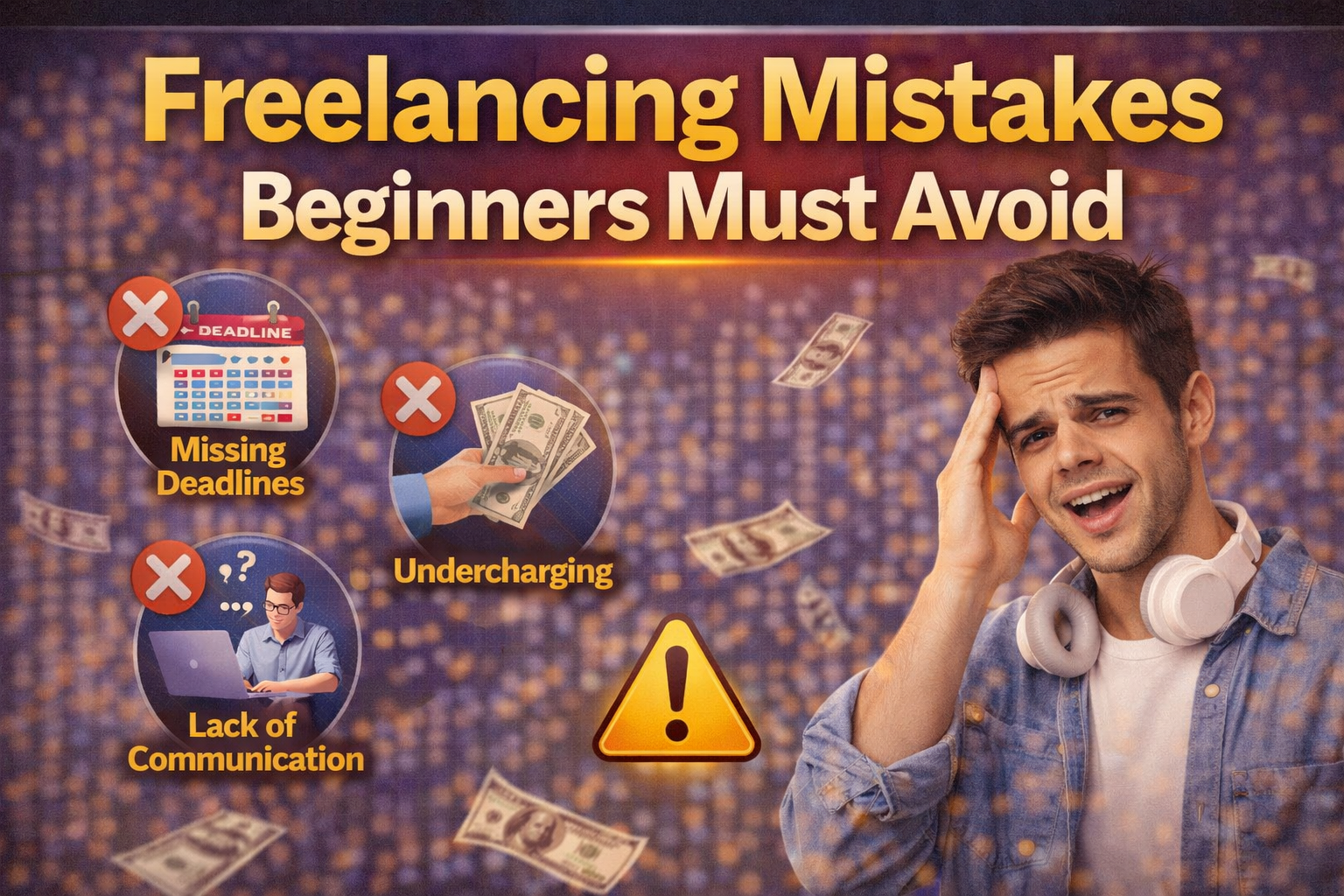
Let me tell you about my first freelancing mistake. Freelancing Mistakes Beginners Must Avoid.
It was my second week as a freelancer. I had landed my first real client—a small business owner who needed a blog post. I was ecstatic. ₹2,000 for 1,000 words. It felt like winning the lottery.
I wrote the post. I poured my heart into it. I sent it over.
The client replied: “This is good, but it’s not quite what I wanted. Can we revise?”
I said yes. Of course I said yes. I revised it. Sent it again.
“Almost there. Just a few more changes.”
I revised again. And again. And again.
Six revisions later, I had spent 20 hours on a ₹2,000 project. I had earned less than minimum wage. I was exhausted, frustrated, and ready to quit freelancing altogether.
That client wasn’t a monster. She was just a client who didn’t know what she wanted. The problem wasn’t her. The problem was me. I had no boundaries. No contract. No scope of work. No limit on revisions. I had made every beginner mistake in the book in my first month.
The mistakes you make as a beginner are expensive—not just in money, but in time, confidence, and motivation. Some mistakes cost you a client. Others cost you weeks of unpaid work. A few can cost you your entire freelancing career if you let them.
In this guide, I’m going to walk you through the most common freelancing mistakes beginners make—and exactly how to avoid them. I’ve made almost every mistake on this list so you don’t have to.
Mistake #1: Not Defining Your Offer Clearly
What it looks like: “I do everything—writing, design, social media, virtual assistance. Whatever you need!”
Why it’s a problem: When you say you do everything, clients hear “I’m not particularly good at anything.” They don’t know what to hire you for. They don’t know what to expect. And they’ll assume you’re a beginner who’s just trying to figure things out.
How to fix it: Pick one service. One niche. One clear offer.
Instead of: “I do social media”
Say: “I create Instagram posts for local cafes and restaurants”
Instead of: “I’m a writer”
Say: “I write blog posts for small business owners who want to attract more customers”
Instead of: “I help with admin work”
Say: “I manage email and calendars for busy entrepreneurs”
The test: If someone asks “What do you do?” and you can’t answer in one clear sentence, your offer isn’t defined yet.
Mistake #2: Competing on Price
What it looks like: “I’ll write a blog post for ₹200.” “I’ll design a logo for ₹500.” “I’ll do whatever you need for ₹100/hour.”
Why it’s a problem: When you compete on price, you attract clients who care about only one thing: the lowest price. These clients are often the most demanding, the least appreciative, and the quickest to leave when someone cheaper comes along. You’ll work harder for less money and burn out fast.
How to fix it: Compete on value, not price.
Instead of saying “I’m cheap,” say:
- “I deliver high-quality work on time, every time.”
- “I’ve helped clients increase their traffic by X%.”
- “I specialize in your industry and understand your audience.”
- “I offer clear communication and unlimited revisions within scope.”
The test: If your main selling point is “I’m affordable,” you’re competing in a race to the bottom. There’s always someone cheaper. Focus on what makes you worth more.
Mistake #3: Working Without a Contract
What it looks like: “We’re just doing a small project. I don’t need a contract.” Or “They seem like a nice person. I trust them.”
Why it’s a problem: This is how freelancers get burned. I’ve seen it happen a hundred times. The client disappears after the work is done. They ask for endless revisions. They change the scope mid-project. They pay late. They don’t pay at all.
Without a contract, you have no protection. You can’t enforce payment. You can’t limit revisions. You can’t define what “done” means. You’re relying entirely on the client’s goodwill—and goodwill runs out when money is involved.
How to fix it: Always use a contract. Even for small projects. Even for friends. Even for repeat clients.
What a simple contract should include:
- Scope of work (exactly what you’ll deliver)
- Timeline (when you’ll deliver)
- Payment terms (how much, when, and how)
- Revision policy (how many revisions included)
- Late payment terms (what happens if they don’t pay)
- Cancellation terms (what happens if either party ends the project)
Where to get a contract: You don’t need a lawyer. Use templates:
- Bonsai (free templates for freelancers)
- Hello Bonsai (contract generator)
- Google Docs (search “freelance contract template”)
- Upwork (has built-in contract protections)
The test: If you’re uncomfortable sending a contract to a client, ask yourself why. If you’re afraid they’ll walk away, they’re not a client you want.
Mistake #4: Not Taking a Deposit
What it looks like: “I’ll do the work first, then invoice them after. That’s fair, right?”
Why it’s a problem: You’re essentially giving the client an interest-free loan of your time. If they don’t pay, you’ve worked for free. Even if they do pay, you’re waiting 15-30 days for money you already earned. Meanwhile, you have bills to pay.
How to fix it: Take a deposit before starting work.
Standard deposit structure:
- New clients: 50% upfront, 50% on completion
- Large projects: 30-50% upfront, remainder on completion
- Small projects: 100% upfront (under ₹5,000)
- Retainers: 100% upfront for the month
What to say:
“I require a 50% deposit to reserve your spot in my schedule. The remaining 50% is due upon completion before final files are delivered.”
The test: If a client refuses to pay a deposit, they’re either not serious, not trustworthy, or don’t have the budget. In all three cases, it’s a red flag.
Mistake #5: Saying Yes to Everything
What it looks like: “Can you also design a logo?” (You’re a writer.) “Sure!” “Can you build a website?” (You’ve never built a website.) “I can try!” “Can you manage our Facebook ads?” (You’ve never run an ad.) “How hard can it be?”
Why it’s a problem: You end up delivering mediocre work outside your expertise. The client is unhappy. You’re stressed. And you’ve wasted time you could have spent on work you’re actually good at.
How to fix it: Learn to say no. Or say “not yet.”
Better responses:
- “That’s not in my scope, but I can recommend someone who specializes in that.”
- “I don’t offer that service yet, but I’m happy to stick to what we agreed on.”
- “I can do that, but it would increase the timeline and cost. Let me send a revised proposal.”
The test: If you find yourself Googling “how to do X” after saying yes to a client, you probably should have said no.
Mistake #6: Underestimating How Long Things Take
What it looks like: “I can finish this in two days.” (You finish in five.) “That’s fine, I have time.” (You don’t.)
Why it’s a problem: You miss deadlines. Clients lose trust. You work nights and weekends to catch up. You burn out. You start dreading client messages because you know you’re behind.
How to fix it: Estimate time, then double it.
When I started, I thought a blog post took 2 hours. It actually took 4. Now I estimate 5-6 to account for research, revisions, and the unexpected.
Why this works:
- You deliver early more often than late
- You have buffer for emergencies
- You’re less stressed
- Clients are happier when you deliver ahead of schedule
The test: If you’re consistently delivering late, your estimates are too optimistic. Add 50% more time to everything.
Mistake #7: Not Having a Scope of Work
What it looks like: “I’ll write a blog post for you.” No details. No word count. No topics. No research requirements. No revision limits.
Why it’s a problem: This is how you end up in revision hell. The client doesn’t know what “done” looks like. You don’t know what you’ve committed to. Every request becomes “part of the project” because nothing was excluded.
How to fix it: Define the scope before starting. In writing.
What a scope should include:
- Deliverables (what exactly you’re creating)
- Quantity (word count, number of designs, hours of work)
- Timeline (deadlines for drafts and final delivery)
- Revisions (how many rounds, what counts as a revision)
- Exclusions (what you’re NOT doing)
Example:
*”This project includes: one 1,200-word blog post on ‘5 Ways to Improve Your SEO.’ Includes keyword research and one round of revisions. Does not include: social media promotion, graphic design, or additional blog posts.”*
The test: If a client asks for something and you’re not sure if it’s included, your scope wasn’t clear enough.
Mistake #8: Using Complex Invoicing and Tracking Methods
What it looks like: “I’ll just send them an invoice when I’m done.” No tracking. No system. No reminders. No payment terms.
Why it’s a problem: You don’t know who has paid and who hasn’t. You forget to send invoices. Clients forget to pay. You’re chasing payments for weeks. You have no idea how much money you’re actually making.
How to fix it: Use a simple system. Free tools exist.
Free invoicing tools:
- Wave (free invoicing and accounting)
- Zoho Invoice (free for up to 50 invoices/year)
- Google Docs (invoice template, manually track payments)
- PayPal (invoicing included)
What your invoice should include:
- Invoice number (start with 001, easy to track)
- Your name and contact info
- Client name and contact info
- Date of invoice
- Payment due date (e.g., “Due within 15 days”)
- Line items with descriptions and amounts
- Total amount
- Payment instructions (UPI, bank transfer, PayPal)
The test: If you don’t know exactly how much money you’re owed right now, your invoicing system is broken.
Mistake #9: Chasing the Wrong Clients
What it looks like: Taking every client who says yes. Ignoring the red flags because “money is money.”
Red flags to watch for:
- They haggle on price aggressively
- They don’t respond to messages for days
- They give vague feedback (“make it pop”)
- They ask for work before discussing payment
- They’ve had “bad experiences” with every freelancer they’ve hired
- They want you to start immediately without a contract
- They ask for free samples before discussing scope
Why it’s a problem: Bad clients cost more than they pay. They take up your time, drain your energy, and damage your confidence. One bad client can make you want to quit freelancing entirely.
How to fix it: Learn to spot red flags early. Trust your gut.
Better to have:
- 3 good clients paying ₹5,000 each = ₹15,000, low stress
- 5 bad clients paying ₹3,000 each = ₹15,000, high stress
The money is the same. Your sanity isn’t.
The test: If you dread seeing a client’s name in your inbox, they’re a bad client.
Mistake #10: Undercharging Established Clients
What it looks like: “They’ve been with me since I started. I can’t raise my rates. They’re loyal.”
Why it’s a problem: Your costs go up. Your skills improve. Your value increases. But your income stays the same because you’re afraid to have a conversation.
How to fix it: Raise your rates regularly. For existing clients, give notice.
Rate raise script:
“Hi [client], I’ve really enjoyed working with you over the past [time]. As my skills and experience have grown, my rates are increasing starting [date]. Your new rate will be [amount]. I wanted to give you plenty of notice so you can plan accordingly. I’d love to continue working together, and I completely understand if this doesn’t work for your budget.”
What to expect:
- Some clients will say yes
- Some will negotiate
- Some will leave
- All of these outcomes are okay
The test: If you haven’t raised your rates in the last 12 months, you’re undercharging.
Mistake #11: Not Saving for Taxes
What it looks like: “I’ll worry about taxes later. Right now, I need the money.”
Why it’s a problem: Tax season arrives and you owe ₹50,000 you didn’t set aside. You scramble to pay it. You take on bad clients to cover the gap. You stress for weeks.
How to fix it: Set aside 30% of every payment. Immediately. Don’t touch it.
How to do it:
- Open a separate bank account (even a basic savings account)
- Every time you get paid, transfer 30% to this account
- Pretend this money doesn’t exist
- When taxes are due, the money is already there
The test: If you’re not setting aside money for taxes, tax season will be a crisis instead of an admin task.
Mistake #12: Neglecting Your Own Brand
What it looks like: All your time goes to client work. You never update your portfolio. You don’t post anywhere. You don’t network. You don’t have a website. You rely entirely on word of mouth and platforms like Upwork.
Why it’s a problem: When your only source of clients is platforms or referrals, you have no control. If Upwork changes its algorithm, your income drops. If your main client leaves, you’re starting from zero.
How to fix it: Spend 10% of your time on your own brand.
What that looks like:
- One portfolio update per month
- One LinkedIn post per week
- One conversation with someone in your industry
- One simple website (Notion or Canva is fine)
- Collecting testimonials after every project
The test: If your only way to find clients is applying to Upwork jobs, you’re one algorithm change away from zero income.
Mistake #13: Not Tracking Your Finances
What it looks like: “I made about ₹30,000 this month. I think. Maybe ₹25,000. Let me check my bank account… oh, that’s from last month.”
Why it’s a problem: You don’t know what’s working. You don’t know which clients are profitable. You don’t know if you’re actually making progress. You can’t make informed decisions.
How to fix it: Track three numbers.
What to track:
- Income: How much you earned this month (total)
- Hours: How many hours you worked
- Rate: Divide income by hours (your effective hourly rate)
Free tracking tools:
- Google Sheets (simple income/expense tracker)
- Wave (free accounting)
- Zoho Expense (free tier)
The test: If you don’t know your effective hourly rate, you don’t know if you’re actually making money.
Mistake #14: Working in Isolation
What it looks like: “I’m a freelancer. I work alone. That’s the point.”
Why it’s a problem: Freelancing can be lonely. You have no one to ask for advice. No one to celebrate wins with. No one to commiserate with when things go wrong. You miss out on referrals, collaborations, and learning from others.
How to fix it: Build a freelancer community.
Where to connect:
- Freelancers India (Facebook group, very active)
- Reddit: r/freelance, r/Upwork
- Local freelancer meetups (check Meetup.com)
- Coworking spaces (even one day a week)
- Twitter/X (follow other freelancers, engage genuinely)
The test: If you haven’t talked to another freelancer in the last month, you’re working in isolation.
Mistake #15: Not Knowing When to Stop
What it looks like: Working 60-hour weeks. Taking on every client. Never saying no. Constantly exhausted. Convinced that if you just work a little harder, you’ll finally feel secure.
Why it’s a problem: This is the fast track to burnout. And burnout doesn’t just affect your work—it affects your health, your relationships, and your desire to keep freelancing at all.
How to fix it: Set boundaries. Treat your freelancing like a business, not a hustle.
Boundaries to set:
- Working hours (9-5, or whatever works for you)
- No client calls after 7 PM
- No weekend work unless emergency (and emergencies are rare)
- One day a week with no screens
- Regular breaks during the day
The test: If you can’t remember the last time you took a full day off, you’re heading for burnout.
Quick Reference: Mistakes and Fixes
| Mistake | Quick Fix |
|---|---|
| Unclear offer | Pick one service, one niche, one sentence |
| Competing on price | Compete on value, not cost |
| No contract | Use a template. Always. Even for friends. |
| No deposit | 50% upfront for new clients |
| Saying yes to everything | “That’s outside my scope” |
| Underestimating time | Estimate, then double it |
| Vague scope | Define deliverables, quantity, timeline |
| Complex invoicing | Use Wave or Zoho. Track everything. |
| Chasing bad clients | Spot red flags early. Say no. |
| Undercharging | Raise rates yearly. Give notice. |
| No tax savings | Set aside 30% of every payment |
| Neglecting your brand | 10% of your time on yourself |
| Not tracking finances | Track income, hours, effective rate |
| Working alone | Join a freelancer community |
| No boundaries | Set hours. Take breaks. Rest. |
Frequently Asked Questions (FAQs)
1. What’s the single biggest mistake beginners make?
Not defining a clear offer. Beginners try to do everything and end up doing nothing well. Pick one service, one niche, one clear sentence that describes what you do.
2. How do I raise rates without losing clients?
Give notice. Be professional. Some clients will leave. That’s okay. The ones who stay are the ones who value your work. The ones who leave were going to leave eventually when someone cheaper came along.
3. What should I do when a client doesn’t pay?
Send a reminder. Then another. Then a final notice. If they still don’t pay, small claims court is an option. But for small amounts, it’s often better to write it off and focus on finding better clients. Prevent this by taking deposits and having contracts.
4. How do I handle difficult clients?
Stay professional. Don’t argue. Deliver what you promised, nothing more. Finish the project. Don’t work with them again. The best way to handle difficult clients is to not work with them in the first place—spot red flags early.
5. Is it okay to say no to clients?
Yes. In fact, it’s essential. Saying no to bad clients means you have time and energy for good clients. Saying no to work outside your scope means you deliver better work in your specialty. Saying no is a skill. Learn it.
6. How do I know if I’m charging enough?
Track your effective hourly rate. If it’s less than you’d be happy earning at a job, you’re not charging enough. If you’re constantly stressed about money, you’re not charging enough. If you haven’t raised rates in a year, you’re not charging enough.
7. What if I’ve already made some of these mistakes?
Everyone has. I’ve made every mistake on this list. The key is to recognize them and fix them. One bad project doesn’t define your career. What you learn from it does.
Final Thoughts
When I look back at my first year freelancing, I cringe. I made every mistake on this list—often multiple times. I worked for clients who never paid. I said yes to work I had no business doing. I spent hours on revisions that should have taken minutes. I almost quit twice.
But each mistake taught me something. Each bad client taught me what to look for. Each failed project taught me what to include in my contracts. Each underpaid week taught me the value of my time.
Freelancing is a skill. And like any skill, you learn by doing—and by failing. But you don’t have to make every mistake yourself. That’s why I wrote this guide.
Print it out. Bookmark it. Come back to it when you’re frustrated, confused, or tempted to take a client you know you shouldn’t.
Freelancing can be incredible. It’s given me freedom, flexibility, and income I never thought possible. But it only works if you run it like a business—not a hobby, not a favor factory, not a series of emergencies.
Set boundaries. Use contracts. Take deposits. Value your time. Say no to bad clients.
Your future freelancing self will thank you.
Which mistake have you made (or are you worried about making)? Drop a comment below. I’d love to help you avoid the ones I didn’t.