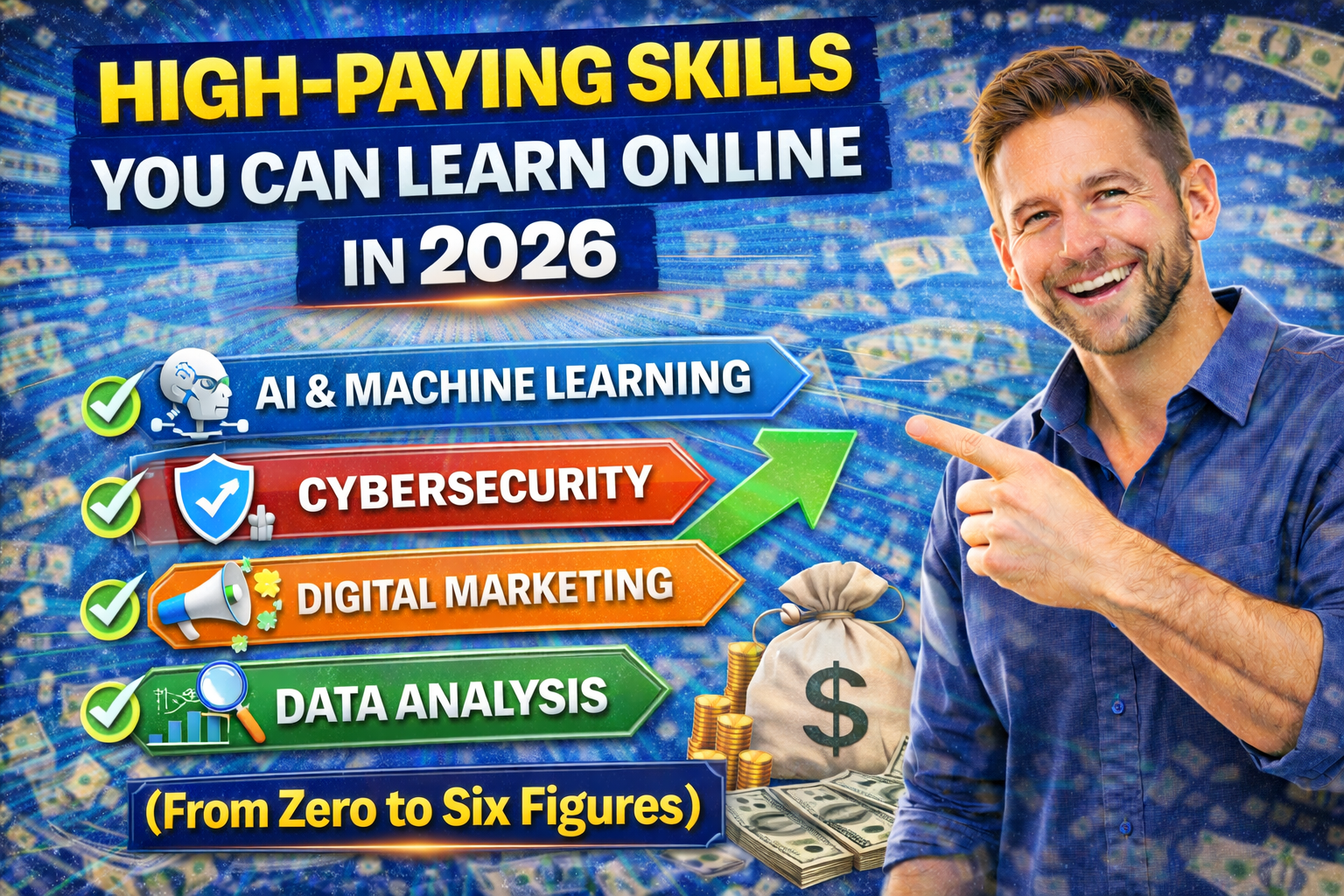
The rules of career success have changed. High-Paying Skills You Can Learn Online in 2026.
Gone are the days when you needed a four-year degree and a mountain of student debt to land a high-paying job. In 2026, employers care about one thing above all else: Can you do the work?
The online learning revolution has made it possible to acquire six-figure skills from your living room. Whether you’re looking to switch careers, boost your current income, or build a freelance empire, there’s never been a better time to invest in yourself.
But here’s the challenge: With thousands of courses available, what should you actually learn?
I’ve done the research for you. Based on current job market data, salary trends, and employer demand, here are the highest-paying skills you can learn online in 2026—and exactly how to get started.
1. Artificial Intelligence & Machine Learning: The Golden Ticket
Let’s start with the elephant in the room. AI isn’t just hype anymore—it’s transforming every industry, and companies are desperate for people who understand it.
Why it pays: AI specialists are among the highest-paid professionals in the world right now. In the US, salaries range from $150K to $300K . In India, freshers can expect ₹7–20 LPA, with experienced professionals commanding much more . In London, senior AI specialists are seeing salary premiums of 56% over non-AI roles, often exceeding £120,000 .
What you’ll learn:
- Python programming (the language of AI)
- Machine learning algorithms and neural networks
- Frameworks like TensorFlow 3.0 and PyTorch 3.0
- LangChain for building AI applications
- Natural Language Processing (NLP)
- AI model deployment and ethics
The hot new specialty for 2026: AI Agents. These aren’t chatbots—they’re autonomous digital teammates that can plan, execute, and complete complex tasks across multiple tools. Professionals with agentic AI skills are seeing salaries 1.5× higher than their peers .
Where to learn:
Pro tip: Don’t just learn theory. Build projects. Create a chatbot, build an image recognition app, or develop a predictive analytics dashboard. Employers want to see what you can DO .
2. Data Science & Analytics: The Storytellers of the Digital Age
Every company is sitting on mountains of data. They need people who can make sense of it.
Why it pays: Data scientists and analysts are crucial for data-driven decision-making. US median pay is around $112,590 with 33% projected job growth through 2034 . In India, salaries range from ₹6–22 LPA . Data governance and AI Ethics specialists are particularly hot due to new regulations like the EU AI Act .
What you’ll learn:
- Python and R programming
- SQL for database querying
- Statistical analysis and data modeling
- Data visualization with Tableau or Power BI
- Big data tools like Hadoop and Spark
Where to learn:
The Google certificate advantage: According to Google’s 2025 Impact Report, 70% of US graduates report a positive career outcome (new job, promotion, or raise) within six months of completing one of their certificates .
3. Cybersecurity: The Digital Bodyguards
As our world becomes more digital, the people who protect it become more valuable.
Why it pays: Cybersecurity threats are increasing exponentially, and talent is scarce. US median salary for information security analysts: $120,360 with 29% projected job growth through 2034 . In India: ₹6–20 LPA . There are over 500,000 cybersecurity-related job postings in the US alone .
What you’ll learn:
- Network security and penetration testing
- Zero Trust Architecture
- Cloud security (CSPM/CWPP)
- API security and threat hunting
- Ethical hacking techniques
- AI Security & Adversarial ML
Where to learn:
Stacking strategy: The Google certificate + CompTIA Security+ is a powerful combination that makes you highly competitive for entry-level roles .
4. Cloud Computing & DevOps: The Infrastructure Architects
The cloud runs everything now. Someone has to build and maintain it.
Why it pays: Cloud adoption continues to grow across all industries. US entry-level roles average $86,000, with Solutions Architects earning around $145,000 . In India: ₹6–18 LPA . Cloud/DevOps engineers are essential for scalable, secure, and automated solutions .
What you’ll learn:
- Cloud platforms: AWS, Azure, or Google Cloud
- Docker and Kubernetes for containerization
- CI/CD pipelines (GitHub Actions, GitLab CI)
- Infrastructure as Code (Terraform, Pulumi)
- Monitoring with Prometheus and Grafana
Where to learn:
The certification path: Start with AWS Cloud Practitioner, then move to Solutions Architect Associate. Each certification can significantly boost your earning potential .
5. Full-Stack Web Development: The Digital Builders
Every business needs a website. Every startup needs an app. Web developers build them.
Why it pays: Full-stack developers who can handle both frontend and backend are incredibly versatile and employable. US salaries: $100K–$180K . India: ₹5–22 LPA . Startups and SaaS companies particularly need end-to-end builders .
What you’ll learn:
- Frontend: React 19, Next.js 15, Vue 4, Tailwind CSS
- Backend: Node.js, Python (FastAPI/Django), Go, Rust
- Databases: MongoDB, MySQL, PostgreSQL
- API design and integration
Where to learn:
| Course | Platform | Duration | Cost |
|---|---|---|---|
| Full Stack Development | IIITB via upGrad | 9 months | Paid |
| The Odin Project | theodinproject.com | Self-paced | Free |
| Full Stack Open | fullstackopen.com | Self-paced | Free |
| React.js For Beginners | upGrad (Free Course) | Self-paced | Free |
The MERN stack advantage: MongoDB, Express, React, and Node.js form a powerful combination that’s widely used in industry .
6. Digital Marketing & Growth: The Revenue Drivers
Companies can’t survive without customers. Digital marketers bring them in.
Why it pays: Marketing has shifted from intuition to data-backed strategies. India salaries: ₹4–15 LPA . In the US, marketing managers are seeing strong pay raises as companies depend more on digital strategies . The demand for digital growth experts continues to increase .
What you’ll learn:
- SEO and SEM strategies
- Social media marketing
- Performance marketing and Google Analytics
- Content marketing and email campaigns
- Marketing analytics and consumer behavior
Where to learn:
| Course | Platform | Duration | Cost |
|---|---|---|---|
| Google Digital Marketing & E-commerce Certificate | Coursera | ~6 months | $49/month |
| Digital Marketing Specialization | University of Illinois via Coursera | 4-6 months | Paid |
| HubSpot Academy | HubSpot | Self-paced | Free |
| Facebook Blueprint | Meta | Self-paced | Free |
The analytics edge: Marketers who understand data are the ones getting promoted. Add Google Analytics certification to stand out .
7. UI/UX Design: The Experience Architects
In a world of endless digital options, the best experience wins.
Why it pays: As digital products become more complex, user experience determines success. India salaries: ₹4–16 LPA . US product designers command strong salaries as companies compete to create intuitive, delightful experiences.
What you’ll learn:
- User research and persona development
- Wireframing and prototyping
- Interaction design and usability testing
- Tools: Figma, Adobe XD, Sketch
- Design thinking methodology
Where to learn:
| Course | Platform | Duration | Cost |
|---|---|---|---|
| Google UX Design Professional Certificate | Coursera | ~6 months | $49/month |
| Interaction Design Specialization | UC San Diego via Coursera | 4-6 months | Paid |
| Figma Academy | figma.com/community | Self-paced | Free |
| UI/UX Design Bootcamp | Various | 3-6 months | Varies |
Portover over theory: In design, your portfolio matters more than your credentials. Build case studies showing your process from research to final design .
8. Blockchain & Web3: The Decentralization Pioneers
While crypto prices fluctuate, the underlying technology continues to evolve and find real-world applications.
Why it pays: Blockchain developers are still scarce relative to demand. India salaries: ₹8–20 LPA . US: $100K–$200K . Fintech, logistics, and supply chain are adopting blockchain for transparency and efficiency.
What you’ll learn:
- Smart contract development (Solidity, Vyper)
- Blockchain platforms: Ethereum, Solana, Near
- Web3 libraries: Ethers.js, Viem
- Development tools: Hardhat, Foundry
- DeFi and NFT development
Where to learn:
| Course | Platform | Duration | Cost |
|---|---|---|---|
| Blockchain Specialization | University at Buffalo via Coursera | 4 months | Paid |
| Ethereum Developer Course | Udemy | Self-paced | Paid |
| CryptoZombies | cryptozombies.io | Self-paced | Free |
| Solidity Documentation | docs.soliditylang.org | Self-paced | Free |
Reality check: This field changes fast. Be prepared for continuous learning as the technology evolves .
9. Project Management: The People Who Make Things Happen
Someone has to keep the trains running on time. That someone is a project manager.
Why it pays: Project management skills transfer across industries—tech, healthcare, construction, nonprofits. Indeed ranks it among top 50 jobs for 2026 with median pay around $87,000 . With PMP certification, median salaries hit $135,000—24% higher than non-certified peers . India: ₹9–25 LPA for product management roles .
What you’ll learn:
- Project planning and scheduling
- Budgeting and resource allocation
- Stakeholder communication
- Agile and Scrum methodologies
- Risk management
Where to learn:
The career path: Start with the Google certificate for entry-level roles like project coordinator. After gaining experience, pursue the PMP for the salary jump .
10. Renewable Energy & Sustainability: The Green Collar Workforce
Climate change isn’t waiting, and neither is the job market.
Why it pays: Green jobs are growing twice as fast as the rest of the economy, with a 23% pay premium compared to traditional engineering roles . India salaries: ₹5–18 LPA . The UK’s push for “Clean Energy Superpower” status is creating massive demand for grid modernization engineers and wind farm technicians .
What you’ll learn:
- Solar and wind energy systems
- Grid modernization
- Energy efficiency auditing
- Sustainability frameworks
- Environmental impact assessment
Where to learn:
| Course | Platform | Duration | Cost |
|---|---|---|---|
| Renewable Energy and Green Building | Coursera | Self-paced | Paid |
| Solar Energy Engineering | edX | Self-paced | Paid |
| Sustainable Energy | MIT OpenCourseWare | Self-paced | Free |
| Energy Efficiency Fundamentals | Alison | Self-paced | Free |
The niche opportunity: Heat pump installers and EV charging point technicians—traditional trades retrained for the green economy—are in particularly high demand .
The T-Shaped Professional: Your Secret Weapon
Here’s something the course catalogs won’t tell you: The most valuable people aren’t one-dimensional.
The World Economic Forum’s Future of Jobs Report identifies analytical thinking, creative thinking, and AI competencies as the fastest-rising skills . But they also emphasize “durable” human skills.
The most successful professionals in 2026 will be T-shaped:
- The vertical bar: Deep expertise in one area (your main skill)
- The horizontal bar: Broad fluency across AI, data, and communication
This combination makes you invaluable because you can both execute specialized work AND collaborate across teams.
Durable skills to develop alongside technical ones:
- Communication and storytelling
- Problem-solving in ambiguity
- Leadership and influencing
- Adaptability and resilience
- Ethical judgment
Your 6-Month Learning Plan for 2026
Want a roadmap? Here’s a practical schedule adapted from expert recommendations :
Months 1-2 (Foundation):
- Complete a function-specific GenAI course
- Learn data basics (SQL or a BI tool)
- Build one small project that automates or improves something
Months 3-4 (Depth):
- Dive deep into your chosen specialty
- Take a project from start to finish
- Document your process and results
Months 5-6 (Credential & Portfolio):
- Earn a recognized certification
- Build a portfolio showcasing 2-3 projects
- Update LinkedIn and start applying or pitching
Pro tip: Small, consistent bets beat big resolutions. One hour a day for six months equals roughly 180 hours—enough to become genuinely competent in almost any skill .
Where to Learn: The Best Platforms for 2026
Premium Platforms:
- Coursera: University-backed courses, professional certificates, degrees
- edX: Similar to Coursera, strong on STEM
- upGrad: Excellent for Indian learners, industry-focused programs
- Udemy: Massive library, frequent sales, good for specific tools
Free Options:
- SWAYAM/NPTEL: Government of India initiative, recognized certificates
- MIT OpenCourseWare: World-class education, completely free
- YouTube: Endless tutorials (channels like FreeCodeCamp, Traversy Media)
- GitHub: Learn from real code, contribute to open source
Government-Approved Free Courses (India):
- NPTEL – Introduction to Programming in C (IIT Madras) – Exam fee ₹1,000
- SWAYAM – Data Analytics with Python – Varies
- AICTE – Introduction to Cyber Security – Free
The Bottom Line: Your Future Starts Today
Here’s the truth: The skills that pay the most are the ones that are hardest to find. But “hard” doesn’t mean “impossible.” It just means “most people give up.”
The people who will thrive in 2026 aren’t necessarily the smartest or the most talented. They’re the ones who:
- Pick one skill and stick with it (no shiny object syndrome)
- Build real projects (theory is worthless without application)
- Show their work (portfolios beat resumes)
- Keep learning (the market never stops evolving)
The cost of entry? A laptop, an internet connection, and your time. No student loans. No four-year waiting period. Just focused effort applied consistently.
So which skill speaks to you? Drop a comment below—I’d love to hear what you’re planning to learn and help you figure out your first step. Your six-figure career is waiting.