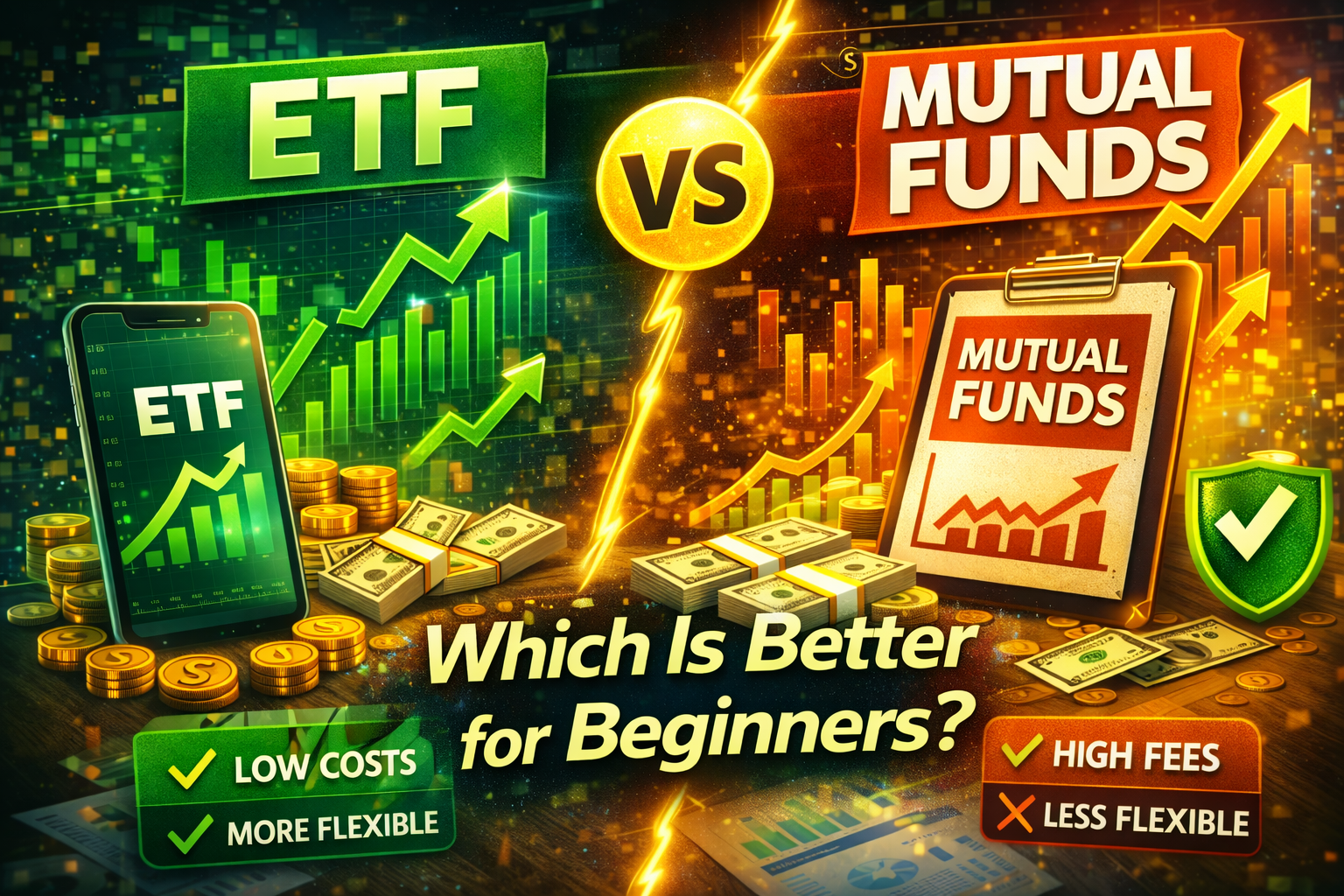
If you’re new to investing, you’ve likely come across two terms that sound similar but aren’t quite the same: ETFs and mutual funds. They’re both popular ways to invest, and deciding between them is one of the first real decisions you’ll make as a beginner ETF vs. Mutual Funds: Which Is Better for Beginners?
The good news? You can’t really go wrong with either. Both are excellent tools that let you buy a basket of stocks, bonds, or other assets in a single transaction—giving you instant diversification without needing to pick individual winners . But they work differently, and one will likely feel more comfortable for your personality and goals than the other.
This guide breaks down exactly how ETFs and mutual funds compare, with clear examples and practical advice for beginners in 2026.
What Are ETFs and Mutual Funds, Anyway?
Let’s start with the basics. Both ETFs and mutual funds are pooled investment vehicles. That means they take money from many investors and use it to buy a diversified portfolio of stocks, bonds, or other assets .
Think of them like a basket of investments. Instead of buying one apple (a single stock), you buy a basket filled with apples, oranges, bananas, and grapes. If one fruit goes bad, you still have the others.
The key difference is how you buy that basket and what happens after you own it.
Side-by-Side Comparison
Here’s a quick snapshot of how ETFs and mutual funds compare on the features that matter most to beginners:
| Feature | Exchange-Traded Fund (ETF) | Mutual Fund |
|---|---|---|
| Trading & Pricing | Trades like a stock on an exchange. Price changes throughout the day based on supply and demand . | Priced once per day after markets close, based on the fund’s Net Asset Value (NAV) . |
| Management Style | Most are passively managed, meaning they track an index (like the S&P 500). Actively managed ETFs are becoming more common but still a minority . | Can be actively managed (a manager picks investments to beat the market) or passively managed (index funds) . |
| Costs (Expense Ratios) | Generally lower, often below 0.10% for index ETFs . | Varies widely. Index funds can be ultra-low (under 0.05%), while actively managed funds can be 0.50% to 1.00% or higher . |
| Minimum Investment | The price of one share. With fractional shares, you can start with as little as $1 at many brokers . | Varies by fund. Some have $0 minimums, others require $500, $1,000, or more . |
| Tax Efficiency | Generally more tax-efficient due to their unique creation/redemption process . | Can be less tax-efficient, especially actively managed funds that trade frequently and distribute capital gains . |
| Automatic Investing | Limited. You can buy fractional shares, but setting up automatic recurring purchases is harder at many brokers . | Excellent for automation. You can set up automatic investments (e.g., $100 monthly) easily . |
| Dividend Handling | Dividends are typically paid out in cash, which you can reinvest automatically through a DRIP (Dividend Reinvestment Plan) . | Dividends are usually reinvested automatically to purchase more shares . |
Breaking Down the Key Differences
Let’s explore the most important distinctions in more detail.
1. How They Trade: The “Stock” vs. The “Store”
This is the biggest practical difference.
ETFs trade like stocks. Their price changes throughout the day as buyers and sellers transact. If the fund holds Apple and Microsoft, and those stocks jump midday, the ETF price will likely jump too. You can buy at 10:00 AM, sell at 10:30 AM, use limit orders, and trade options—just like with any stock .
Mutual funds trade once per day. After the market closes, the fund calculates its Net Asset Value (NAV)—the total value of all holdings divided by shares outstanding. Every buy or sell order placed that day executes at that single price .
For beginners: This matters less than you might think. If you’re a long-term buy-and-hold investor, you probably won’t care about intraday price movements. But if you like the idea of being able to trade whenever you want, ETFs offer that flexibility .
2. Costs: The Fee Factor
Fees are the one thing you can control as an investor, and they matter enormously over time. A 1% fee doesn’t sound like much, but over 30 years, it can eat 20-30% of your potential returns .
ETFs generally win on fees. Because most are passively managed and have low operational costs, their expense ratios are often below 0.10% . The Vanguard S&P 500 ETF (VOO) charges 0.03%, meaning you pay $3 per year for every $10,000 invested.
Mutual funds vary wildly. Index mutual funds are also incredibly cheap. The Fidelity 500 Index Fund (FXAIX) charges just 0.015%—even lower than most ETFs . But actively managed mutual funds can charge 0.50% to 1.50% or more. You’re paying for the manager’s expertise, but historically, most active funds fail to beat their benchmark after fees .
The bottom line: For passive index investing, both ETFs and index mutual funds offer rock-bottom fees. For active management, mutual funds are the traditional vehicle, but you’ll pay for it.
3. Minimums: Getting Started
This used to be a major barrier, but in 2026, it’s much less of an issue.
ETFs: You need to buy at least one share. With fractional shares now widely available at brokers like Fidelity, Schwab, and Robinhood, you can start with as little as $1 . So the old “ETFs require a lump sum” argument is mostly obsolete.
Mutual funds: Minimums vary. Many index funds have no minimum (Fidelity’s FXAIX), while others might require $500, $1,000, or more . Actively managed funds often have higher minimums.
For beginners: Both are accessible. If you have $50 to start, you can buy fractional shares of an ETF or put it all in a no-minimum mutual fund.
4. Taxes: The Efficiency Factor
This matters more if you’re investing in a taxable brokerage account (not a retirement account like a 401k or IRA).
ETFs are generally more tax-efficient. Their unique structure allows them to avoid distributing capital gains to shareholders as often as mutual funds . When you sell an ETF, you create your own tax event. When the fund itself sells holdings, it rarely triggers a tax bill for you .
Mutual funds can be less tax-efficient. Actively managed funds that trade frequently can generate capital gains distributions, which you must pay taxes on even if you didn’t sell any shares . Index mutual funds are better, but still slightly less efficient than ETFs due to their structure .
The bottom line: In a retirement account, tax efficiency doesn’t matter. In a taxable account, ETFs have a slight edge, though the difference is small for index funds.
5. Automation: The “Set It and Forget It” Factor
This is where mutual funds still have a clear advantage.
Mutual funds are built for automation. You can set up an automatic investment plan to buy $100 worth of a fund every single month. The money comes from your bank, buys fractional shares, and reinvests dividends—all automatically .
ETFs are catching up but still behind. Many brokers now offer automatic ETF investing, but it’s often limited to whole shares or specific dollar amounts. It’s getting better, but mutual funds are still smoother for true hands-off automation .
For beginners: If you want to automate your investing completely, mutual funds are currently the better choice.
Which Is Better for Beginners? A Decision Framework
There’s no single right answer—it depends on your goals and personality. Here’s how to choose.
Choose ETFs If:
- You want the lowest possible fees for passive index investing
- You like the flexibility of trading throughout the day
- You’re investing in a taxable account and care about tax efficiency
- You prefer to buy in lump sums or use fractional shares at your broker
- You want access to niche strategies (sector-specific, leveraged, etc.)
Best ETF examples:
- Vanguard S&P 500 ETF (VOO) – 0.03% expense ratio
- Vanguard Total Stock Market ETF (VTI) – 0.03%
- Schwab U.S. Broad Market ETF (SCHB) – 0.03%, lower share price
- iShares Core Dividend Growth ETF (DGRO) – 0.08%
Choose Mutual Funds If:
- You want to automate your investments with recurring purchases
- You prefer the simplicity of one price per day
- You’re investing in a retirement account (401k, IRA) where tax efficiency matters less
- You want access to actively managed funds (though consider fees carefully)
- You’re starting with very small amounts at brokers that don’t offer fractional ETF shares
Best mutual fund examples:
- Fidelity 500 Index Fund (FXAIX) – 0.015%, $0 minimum
- Vanguard 500 Index Fund Admiral Shares (VFIAX) – 0.04%, $3,000 minimum
- Schwab S&P 500 Index Fund (SWPPX) – 0.02%, $0 minimum
The Hybrid Approach: Using Both
Many successful investors use both ETFs and mutual funds. Here’s a common strategy:
- In your 401k or IRA: Use mutual funds for automatic monthly investing. Set it and forget it.
- In your taxable brokerage account: Use ETFs for their tax efficiency and flexibility.
- For your core portfolio: Stick with broad market index funds (S&P 500, total stock market) in whichever vehicle works best.
This gives you the best of both worlds: automation where it matters, flexibility where you want it.
Common Beginner Questions
Can I lose money in ETFs and mutual funds?
Yes. Both are investments, not savings accounts. If the market drops, the value of your shares will drop. Over long periods (10+ years), the market has historically gone up, but short-term losses are normal .
Do I need both?
Not at all. Many investors do perfectly well with just one or two funds. A single S&P 500 index fund (in either ETF or mutual fund form) is enough to start building wealth .
Which is better for a Roth IRA?
Both work great. If you want to automate monthly contributions, mutual funds are easier. If you prefer buying in lump sums and holding long-term, ETFs are excellent.
How do I buy them?
Open a brokerage account at Fidelity, Vanguard, Schwab, or any major broker. Then search for the ticker symbol (e.g., VOO or FXAIX) and place your order.
The Bottom Line
For beginners in 2026, the ETF vs. mutual fund debate is less about which is “better” and more about which fits your style .
| If you want… | Choose… |
|---|---|
| Flexibility, intraday trading, lowest fees | ETFs |
| Automation, simplicity, set-it-and-forget-it | Mutual funds |
Both are powerful tools for building long-term wealth. The most important step isn’t choosing the perfect vehicle—it’s starting. Open that account, pick a low-cost index fund that tracks the S&P 500, and invest consistently over time.
Whether you choose VOO or FXAIX, you’ll be owning a piece of America’s largest companies and building toward your financial future. And that’s what really matters.
1 thought on “ETF vs. Mutual Funds: Which Is Better for Beginners? (2026 Guide)”