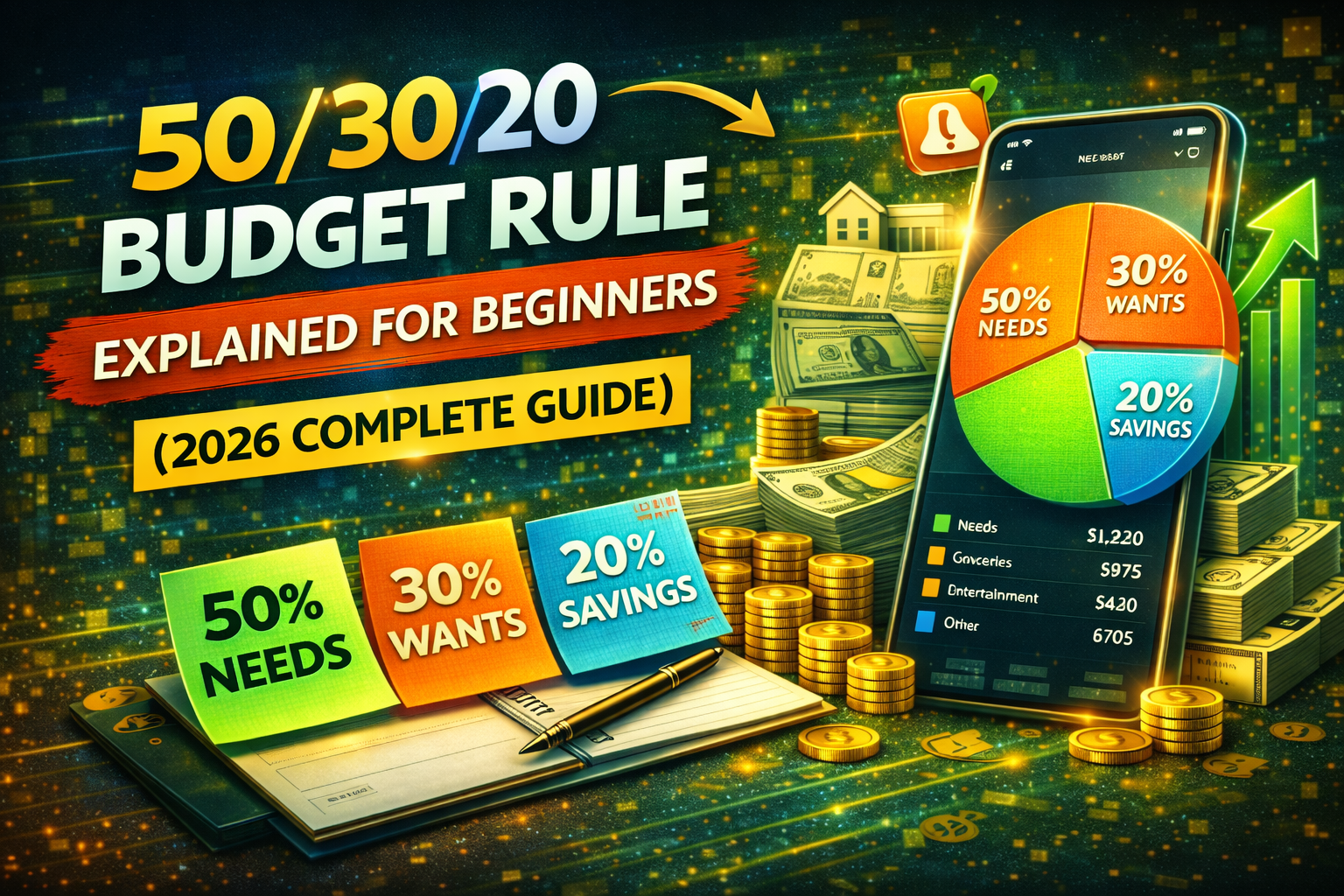
If you’ve ever tried to make a budget and felt overwhelmed by categories, spreadsheets, and the sheer mental energy required to track every dollar, you’re not alone. Traditional budgeting can feel like a part-time job—one you never wanted in the first place. 50/30/20 Budget Rule Explained for Beginners
Enter the 50/30/20 rule. It’s not a budget in the traditional sense. It’s a framework. A philosophy. A way to manage your money that takes about five minutes to understand and even less time to maintain.
Popularized by Senator Elizabeth Warren in her book All Your Worth: The Ultimate Lifetime Money Plan, the 50/30/20 rule has become one of the most recommended budgeting methods for beginners—and for good reason. It’s simple, flexible, and effective.
This guide will walk you through exactly what the 50/30/20 rule is, how to apply it to your own finances, and how to make it work in the economic reality of 2026.
What Is the 50/30/20 Rule?
The 50/30/20 rule is a straightforward framework for managing your after-tax income. You divide your money into three broad categories:
| Category | Percentage | What It Covers |
|---|---|---|
| Needs | 50% | Essentials you must pay to survive |
| Wants | 30% | Non-essentials that make life enjoyable |
| Savings & Debt | 20% | Building future wealth and paying off debt |
That’s it. No complicated categories. No tracking every coffee purchase. Just three buckets that give you a clear picture of your financial health .
The beauty of this system is its flexibility. It doesn’t tell you exactly how much to spend on groceries or entertainment—it gives you guardrails and lets you decide what fits within them .
Breaking Down the Three Categories
Needs: The 50% Bucket
Needs are expenses you absolutely must pay and cannot avoid. These are the things you’d need to survive if you lost your job tomorrow .
Common needs include:
- Rent or mortgage payments
- Utilities (electricity, water, gas, trash)
- Groceries (basic food, not restaurant meals)
- Transportation (car payment, gas, insurance, or public transit)
- Minimum debt payments (credit card minimums, loan payments)
- Health insurance and basic healthcare
- Childcare necessary for work
- Basic clothing (not fashion)
What doesn’t count: That daily latte, restaurant meals, premium cable packages, or the gym membership you never use—those are wants .
Wants: The 30% Bucket
Wants are everything else you spend money on that isn’t strictly necessary. This category is about lifestyle and enjoyment .
Common wants include:
- Dining out and takeout
- Entertainment (movies, concerts, streaming services)
- Vacations and travel
- Hobbies and recreational activities
- Gym memberships and fitness classes
- Premium subscriptions (Spotify, Netflix, etc.)
- Shopping for non-essential items
- Upgraded versions of necessities (buying name-brand instead of store-brand, or a more expensive car than you need)
This 30% bucket is important. If you cut out all your wants, you’ll feel deprived and probably give up on budgeting entirely . The 50/30/20 rule gives you permission to spend on things you enjoy—as long as you stay within the limit .
Savings and Debt: The 20% Bucket
This bucket is for building your financial future and getting out of debt .
What belongs here:
- Emergency fund contributions
- Retirement savings (401(k), IRA)
- Other investments (brokerage accounts)
- Extra debt payments above the minimum
- Savings for large goals (down payment, new car, education)
Important: Only minimum debt payments count as “needs.” Any extra payments you make beyond the minimum belong in this 20% bucket .
Why the 50/30/20 Rule Works for Beginners
1. It’s Simple
You don’t need to track every expense in 47 categories. Just three buckets. This low-maintenance approach makes it much more likely you’ll stick with it .
2. It’s Flexible
Your numbers will change month to month, and that’s fine. One month you might spend more on wants (vacation!), another month you might save extra. The rule provides guidance, not a straitjacket .
3. It Automatically Balances Your Priorities
By design, it ensures you’re covering essentials, leaving room for enjoyment, and building future wealth. Many people naturally overspend on wants or undersave. This rule prevents both .
4. It Works for Most Income Levels
Whether you earn $30,000 or $300,000, the percentages scale. A higher income means more dollars in each bucket, but the framework remains the same .
How to Apply the 50/30/20 Rule in 2026
Step 1: Calculate Your After-Tax Income
Start with your take-home pay—the amount that actually hits your bank account after taxes, retirement contributions, and other deductions .
For salaried employees: Look at your pay stub. If you’re paid monthly, use that number. If you’re paid bi-weekly, multiply by 26 and divide by 12 to get monthly average.
For freelancers or gig workers: Calculate your average monthly income after setting aside money for taxes. You may need to base this on several months of history.
Example: If you take home $4,000 per month after taxes:
- Needs: $2,000
- Wants: $1,200
- Savings/Debt: $800
Step 2: Track Your Current Spending
For one month, track every dollar you spend. Use a budgeting app (like those covered in our previous guide), a spreadsheet, or even a notebook. The goal is to see where your money is actually going, not where you think it’s going .
Categorize each expense as a need, want, or savings/debt payment. At the end of the month, calculate your percentages.
Step 3: Compare and Adjust
Now compare your actual spending to the 50/30/20 targets. Most people find they’re overspending on wants and undersaving .
If you’re over on wants: Look for places to cut back. Maybe reduce dining out, cancel unused subscriptions, or find cheaper entertainment options.
If you’re under on needs: Congratulations—you have more flexibility. Consider increasing your savings rate or giving yourself a slightly higher wants budget.
If you’re under on savings: This is the most common problem. Treat your savings like a bill that must be paid. Automate transfers on payday so you never see the money .
Real-World Examples
Example 1: Single Renter in a City
Income: $3,500/month after taxes
Targets: Needs $1,750 | Wants $1,050 | Savings $700
| Category | Actual | Target | Status |
|---|---|---|---|
| Rent + utilities | $1,400 | ||
| Groceries | $400 | ||
| Transportation | $150 | ||
| Total Needs | $1,950 | $1,750 | $200 over |
| Dining out | $500 | ||
| Streaming | $50 | ||
| Shopping | $300 | ||
| Total Wants | $850 | $1,050 | $200 under |
| Savings | $700 | $700 | On track |
Analysis: This person is overspending on needs (likely rent) and underspending on wants. They’re still hitting their savings goal because they’re frugal elsewhere. The fix isn’t to cut savings—it’s to recognize that with high housing costs, they may need to adjust expectations or find ways to increase income.
Example 2: Family of Four in Suburbs
Income: $6,000/month after taxes
Targets: Needs $3,000 | Wants $1,800 | Savings $1,200
| Category | Actual | Target | Status |
|---|---|---|---|
| Mortgage | $1,800 | ||
| Utilities | $400 | ||
| Groceries | $800 | ||
| Insurance | $300 | ||
| Total Needs | $3,300 | $3,000 | $300 over |
| Dining out | $600 | ||
| Entertainment | $200 | ||
| Subscriptions | $100 | ||
| Kids activities | $400 | ||
| Total Wants | $1,300 | $1,800 | $500 under |
| Savings | $1,400 | $1,200 | $200 over |
Analysis: This family is doing great—they’re saving more than the target and spending less on wants. The slight overage on needs is manageable. They could redirect some of that extra savings to pay down the mortgage faster or fund college accounts.
Example 3: Recent Graduate with Student Loans
Income: $2,800/month after taxes
Targets: Needs $1,400 | Wants $840 | Savings $560
| Category | Actual | Target | Status |
|---|---|---|---|
| Rent + utilities | $900 | ||
| Groceries | $300 | ||
| Transportation | $150 | ||
| Min student loan | $200 | ||
| Total Needs | $1,550 | $1,400 | $150 over |
| Dining out | $400 | ||
| Entertainment | $200 | ||
| Subscriptions | $50 | ||
| Total Wants | $650 | $840 | $190 under |
| Extra loan payment | $200 | ||
| Emergency fund | $200 | ||
| Total Savings | $400 | $560 | $160 under |
Analysis: This graduate is making progress but needs to tighten wants further to hit savings targets. Cutting dining out by $200/month would bring them to exactly $560 in savings/debt payments.
Common Questions and Concerns
What if my needs exceed 50%?
This is extremely common, especially in high-cost cities or for those with lower incomes . If your needs are eating up 60% or more of your income, you have three options:
- Reduce needs: Find a cheaper apartment, refinance debt, shop for better insurance rates, cut grocery costs .
- Increase income: Side hustle, ask for a raise, switch jobs .
- Adjust the percentages temporarily: In the short term, you may need to let wants and savings shrink while you work on the first two options .
The goal is to work toward the 50/30/20 ideal, not to achieve it perfectly this month .
Should I include taxes?
No. The 50/30/20 rule applies to after-tax income . If you’re self-employed, make sure you’ve accounted for tax payments before applying the rule .
Where do irregular expenses fit?
Annual bills, car repairs, and irregular expenses can be tricky. The best approach is to treat them as “savings goals” within the 20% bucket. Set aside money each month so you have funds when the bill arrives .
What about retirement contributions through work?
If your employer deducts retirement contributions pre-tax, that money never shows up in your take-home pay. That’s fine—it’s already doing its job. The 20% bucket applies to what’s left after those deductions .
Can I use this if I’m in debt?
Absolutely. In fact, it’s ideal for debt payoff. Your minimum debt payments count as “needs.” Any extra payments you make belong in the 20% bucket. This ensures you’re making progress while still covering essentials and allowing some enjoyment .
Pros and Cons of the 50/30/20 Rule
Pros
- Simple and easy to understand – No complex categories
- Flexible – Adapts to your life and spending patterns
- Balanced – Ensures you cover essentials, enjoy life, and save
- Sustainable – You’re less likely to give up than with strict budgets
Cons
- May not work for very low incomes – Needs often exceed 50%
- Too vague for some – People who need detailed tracking may struggle
- Doesn’t account for all situations – Irregular income, large debts, or unique circumstances may require adjustments
Alternatives to the 50/30/20 Rule
If the 50/30/20 rule feels too loose or doesn’t fit your situation, consider these alternatives :
| Method | Description | Best For |
|---|---|---|
| Zero-based budget | Every dollar gets assigned a job until income minus expenses equals zero | Detail-oriented people who want full control |
| Envelope system | Cash for each category in physical envelopes | People who overspend with cards |
| Pay yourself first | Automate savings, then spend the rest | Those who struggle to save |
| 80/20 rule | Save 20%, spend 80% however you want | Simplicity seekers |
| 60/30/10 rule | 60% needs, 30% wants, 10% savings | Higher-cost living areas |
Tips for Success in 2026
Automate Everything
Set up automatic transfers to savings and automatic payments for bills. The less you have to think about it, the more likely you’ll stick to the plan .
Use a Budgeting App
Apps like YNAB, EveryDollar, or even simple spreadsheets can help you track your categories without manual effort .
Review Monthly
Take 15 minutes at the end of each month to review your spending. Are you on track? Do you need to adjust? This small habit makes a huge difference .
Be Kind to Yourself
You won’t hit the numbers perfectly every month. Life happens. Car repairs, medical bills, and unexpected expenses will throw things off. That’s okay. Adjust and keep going .
Increase Your Savings Rate Over Time
As your income grows or debts are paid off, increase your savings percentage. Many financial independence advocates aim for 50% or more—but that’s a long-term goal, not a starting point .
The Bottom Line
The 50/30/20 budget rule is the perfect starting point for anyone who wants to take control of their finances without getting overwhelmed. It’s simple enough to start today, flexible enough to adapt to your life, and powerful enough to build lasting financial health.
Remember the three buckets:
- 50% for needs – The essentials
- 30% for wants – The fun stuff
- 20% for savings and debt – Your future self
Check your numbers. Make adjustments. Automate what you can. And give yourself grace when life gets messy.
You don’t need to be perfect. You just need to be consistent. Start today, and a year from now, you’ll be amazed at how far you’ve come.
1 thought on “50/30/20 Budget Rule Explained for Beginners (2026 Complete Guide)”